
Reviewed by the Coppell ER emergency care team
| 🚨 Call 911 If Any of These Apply Right Now
Bone is visible through the skin. The limb is bent at an unusual angle. Fingers or toes below the injury are pale, blue, or cold. You cannot feel or move the area below the break. Bleeding will not stop with pressure. The injury involves the head, neck, spine, or hip after a fall or trauma. Any one of these signs, dial 911. Do not drive yourself. Coppell ER is at 720 N Denton Tap Rd. Phone: 469-763-3136. |
How to tell if a fracture is serious matters because most bone injuries are painful but stable, while a small share involve nerve damage, blocked blood flow, or open wounds that can permanently disable a limb without fast treatment. Emergency physicians rely on a short list of danger signs to sort minor breaks from urgent ones. Knowing those signs lets you make the right call in the first crucial minutes after an injury.
Danger Signs That Mean the ER Right Now
| A fracture becomes an emergency when bone is visible through the skin, when the limb looks bent the wrong way, when skin below the injury turns pale or cold, when you cannot move fingers or toes, or when numbness spreads. Any one of these signs of a serious fracture means 911 or the ER now. |
The following fracture warning signs override any other assumption about the injury. Any one of them means immediate evaluation:
Bone visible through the skin. This is an open (compound) fracture. Contamination risk is high and surgery is almost always needed within hours.
Obvious deformity. The limb looks bent, angled, or shortened compared to the other side. Blood vessels or nerves may be compressed.
Numbness or tingling below the injury. A sign that nerves have been stretched, compressed, or torn. Untreated nerve compression can cause permanent loss of feeling.
Pale, blue, or cold skin below the break. Circulation is compromised. Tissue below the injury begins dying within hours without restored blood flow.
No pulse below the injury. A vascular emergency. A limb without pulse needs surgical evaluation immediately.
Uncontrollable bleeding. Any injury bleeding heavily despite pressure needs the ER. Direct pressure at the wound is the correct first step while you get there.
According to the American Academy of Orthopaedic Surgeons, any open fracture is a surgical emergency because contamination can cause a bone infection that may need long-term antibiotics or additional surgeries.¹
How to Tell a Fracture From a Bad Sprain
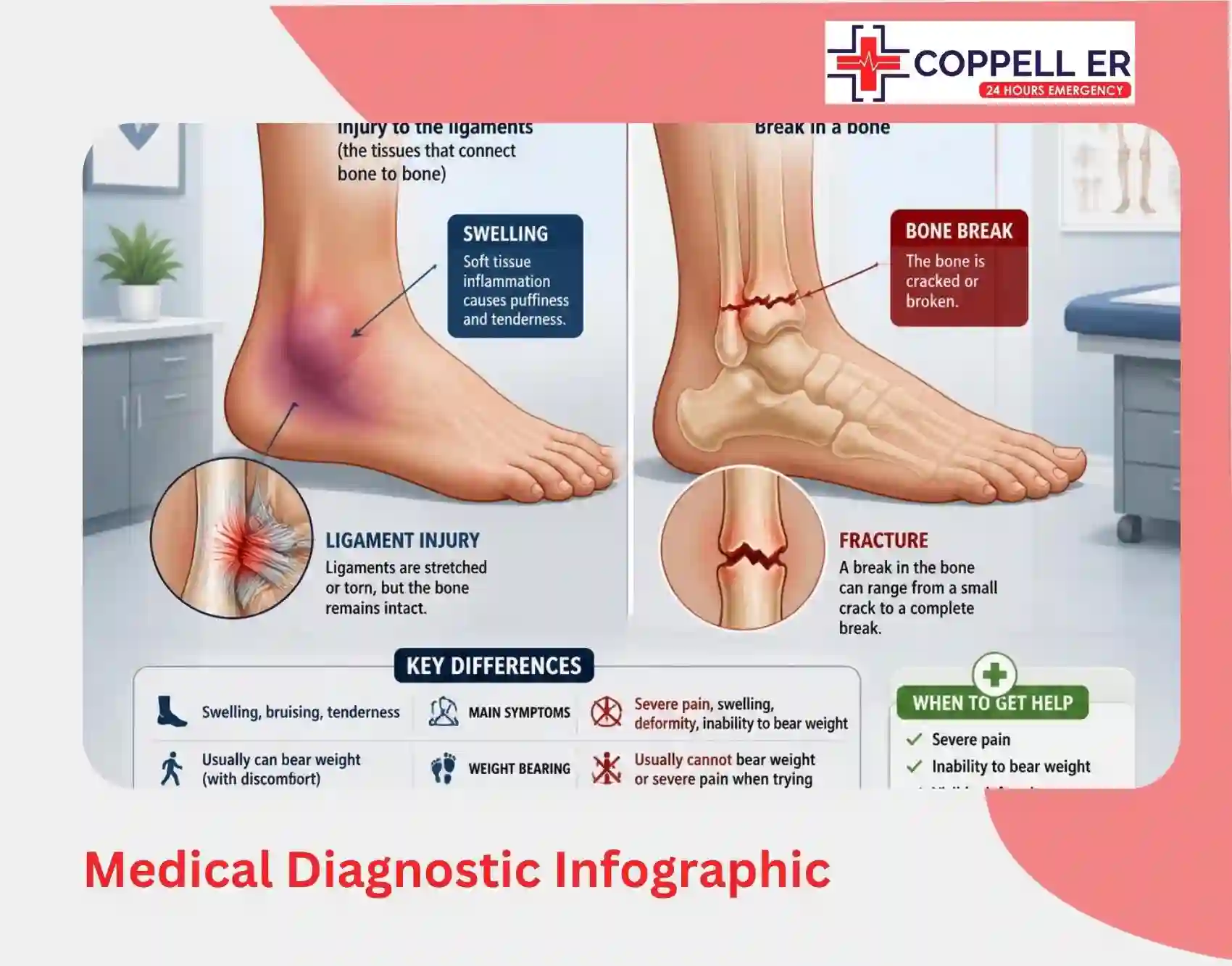
| Sprains and fractures often look alike, especially in the ankle or wrist. The clearest difference: fractures usually cause immediate severe swelling, an inability to bear weight at all, and sometimes a snap or grinding sensation. Sprains tend to swell gradually with partial weight-bearing still possible. |
The broken bone vs sprain question comes up most often for ankle and wrist injuries. Use this quick comparison to help decide, though only imaging can confirm:
| Feature | Likely Fracture | Likely Sprain |
|---|---|---|
| Swelling | Immediate and significant | Develops over hours |
| Weight-bearing | Impossible or unbearable | Painful but possible |
| Sound at injury | Snap, crack, or pop | Usually none |
| Deformity | Possible bump or angle | None |
| Point tenderness | Sharp pain on the bone itself | Pain across a joint or ligament |
The overlap is why imaging matters. On-site X-ray at Coppell ER gives an answer within minutes rather than sending you home guessing.
Fractures That Are Always Emergencies
| Some fractures need emergency evaluation regardless of how the injury looks. Skull, spine, hip, pelvis, and femur breaks fall into this category. So do any open fractures where bone has pierced the skin, and any injury from major trauma like a car crash or long fall. |
These fracture types skip the triage decision entirely. If any of the following is possible, go straight to the ER:
- Skull fracture, especially with any loss of consciousness, confusion, vomiting, or clear fluid leaking from the nose or ear
- Spine or neck fracture, suspected after any high-force injury, fall from height, or diving accident
- Hip fracture, especially in older adults after a fall — hip fractures have a high mortality rate when treatment is delayed
- Pelvis fracture, often caused by significant trauma and associated with serious internal injuries
- Femur (thigh bone) fracture, which can cause dangerous blood loss internally
- Open (compound) fracture of any bone, which is an open fracture emergency by definition
- Multiple fractures from a single incident
- Any fracture in the setting of a car accident, fall from height, or major sports collision
The American Academy of Orthopaedic Surgeons OrthoInfo library emphasizes that a broken bone from severe force may be accompanied by injuries to organs, blood vessels, or nerves that only imaging can identify.²
How to Tell If a Fracture Is Serious for Higher-Risk People
| Older adults with a possible hip fracture, children with pain near a joint, people on blood thinners, and anyone with osteoporosis face higher risks from any bone injury. In these groups, the question of how to tell if a fracture is serious tilts firmly toward getting evaluated sooner rather than later. |
The same injury carries different levels of risk depending on who has it. These groups deserve lower thresholds for ER care:
- Adults over 65 with pain in the hip, groin, or upper thigh after any fall — hip fractures often show subtle signs but need same-day surgery
- Children with pain near a joint, since growth plate injuries can affect long-term bone development if missed
- Anyone on blood thinners, since even minor breaks can lead to hidden internal bleeding
- People with osteoporosis, whose bones can fracture from minimal force
- Diabetics, whose slower healing raises complication risk
- Anyone with a personal history of previous fractures at the same site
- Cancer patients, since some tumors weaken bone and cause pathologic fractures
For families with young ones, our team also offers dedicated pediatric emergency care with imaging protocols calibrated for growing bones.
First Aid Before You Arrive

| Before you arrive at Coppell ER, immobilize the injured area, keep it elevated if possible, and apply cold to reduce swelling. Do not try to straighten a deformed limb, do not remove protruding bone, and do not eat or drink in case surgery becomes necessary. |
Match these action pairs to what you should and should not do while getting to care:
| ✓ DO Immobilize the area with whatever rigid support is available (magazine, splint, folded cardboard). | ✗ DON’T Try to straighten a limb that looks bent or deformed. |
| ✓ DO Apply ice or a cold pack wrapped in cloth for 15-20 minutes at a time. | ✗ DON’T Apply ice directly to broken skin or open wounds. |
| ✓ DO Elevate the injured area above heart level if possible to reduce swelling. | ✗ DON’T Remove clothing over the injury if it requires manipulation of the limb. |
| ✓ DO Cover any open wound with a clean cloth and apply gentle pressure to control bleeding. | ✗ DON’T Push protruding bone back under the skin or attempt to clean deep wounds. |
| ✓ DO Note the exact time the injury happened and any first aid given. | ✗ DON’T Eat or drink anything in case surgery or sedation is needed. |
| ✓ DO Call 911 for suspected head, neck, spine, or hip fractures. | ✗ DON’T Move someone with a suspected spine injury unless they are in immediate danger. |
What Happens at Coppell ER for a Suspected Fracture
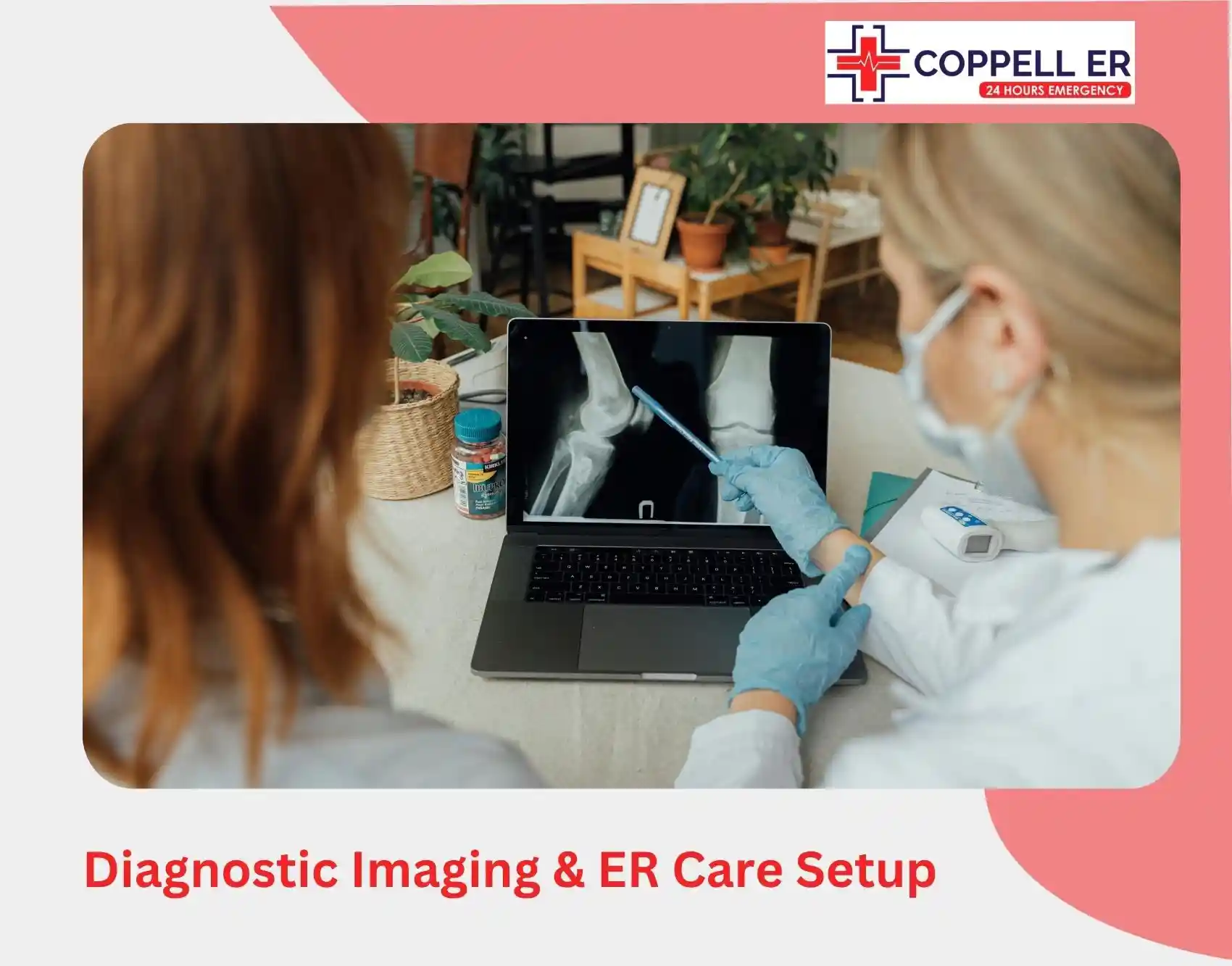
| Evaluation at Coppell ER begins within minutes of walk-in. A board-certified emergency physician examines the injury, checks nerve and blood flow, and orders imaging. Most patients have a diagnosis and treatment plan within an hour of arrival, and the question of when to go to ER for a broken bone becomes a clear next step. |
The typical workup follows this sequence:
- Rapid triage by an emergency physician trained in acute injury evaluation
- Neurovascular check to confirm nerve and blood flow below the injury
- Digital on-site X-ray imaging to confirm or rule out a break, its type, and displacement
- When needed, on-site CT scan for complex fractures of the skull, spine, pelvis, or joints
- Pain management and initial stabilization with splinting or immobilization
- Direct coordination with orthopedic specialists when surgery or advanced procedures are needed
- Discharge planning with clear follow-up instructions, prescriptions, and warning signs to watch
Walk-in care with no long waiting room delays means patients typically get imaging results and a treatment plan in about an hour.
Frequently Asked Questions
How long does it take a fracture to swell?
Fractures typically cause immediate significant swelling within minutes, often visible before you can even see bruising. Sprains tend to develop swelling more gradually over several hours. Rapid swelling raises suspicion for a broken bone.
Can you walk on a broken foot or ankle?
Sometimes, briefly. Small fractures in the foot or a stable ankle break may allow limping. But sharp pain with each step, immediate swelling, and severe point tenderness on the bone still point toward a fracture needing imaging.
Do I need an X-ray if I can move my fingers or toes?
Yes, if pain, swelling, or deformity is present. Being able to move digits helps rule out major nerve damage, but stable fractures can still exist alongside preserved movement. Imaging is the only definitive answer.
What is the difference between a hairline fracture and a serious break?
A hairline fracture is a small crack without displacement, usually treated with immobilization. Serious breaks involve displaced bone, open wounds, nerve or blood vessel injury, or affect high-risk areas like the hip or spine.
Is it worse if I heard a snap or crack when I got hurt?
Usually yes. A distinct snap, crack, or pop at the moment of injury strongly suggests a fracture, not a sprain. Grinding sensations during movement also raise the likelihood and warrant same-day imaging.
Fast Care for Fractures When You Need It
Fractures do not wait for business hours, and neither does Coppell ER. Open 24 hours a day with board-certified emergency physicians, on-site X-ray and CT imaging, and no appointment required. Walk in, get evaluated fast, and get answers about the injury today.
Coppell ER | Open 24/7
720 N Denton Tap Rd, Coppell, TX 75019 | 469-763-3136
Most commercial insurance accepted. In-house billing. No surprise billing.