
Reviewed by the Coppell ER emergency care team
| 🚨 If You Are Not Sure, Call 911
911 is the right call when a condition is life-threatening, when the person cannot be safely moved, when symptoms could worsen rapidly, or when uncertainty is high. Paramedics bring treatment to you, start care immediately, and give the ER advance notice. Coppell ER is at 720 N Denton Tap Rd. For non-life-threatening but urgent symptoms, walk in or call 469-763-3136. |
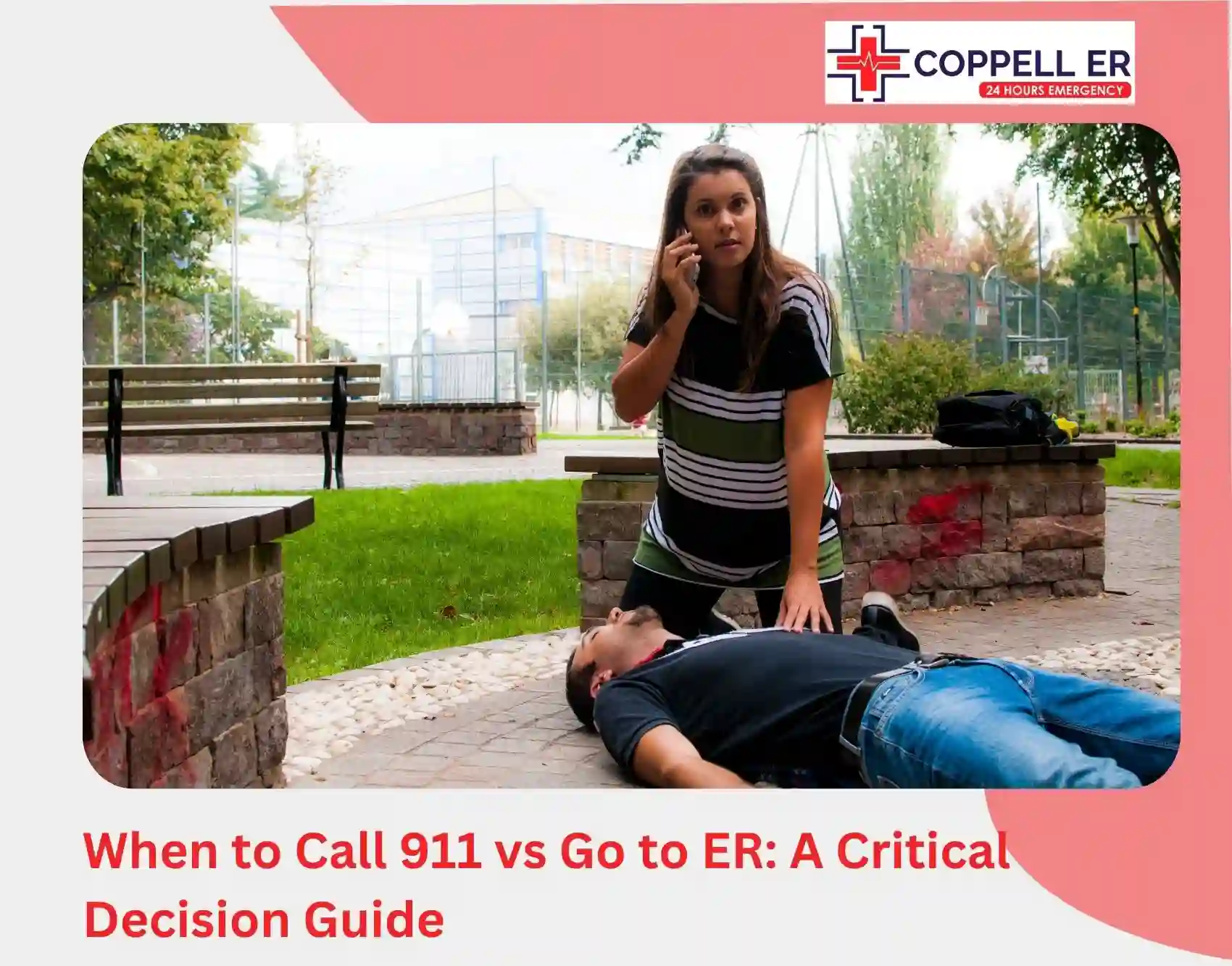
When to call 911 vs go to er is one of the most consequential split-second decisions a Coppell area adult can face, and the wrong call costs minutes that matter in stroke, heart attack, or severe trauma. The short answer: dial 911 whenever the condition could become life-threatening before you reach the hospital, and walk in to the ER when the symptoms are urgent but stable. Knowing the specific scenarios for each saves lives and brain tissue.
This decision guide, built for Coppell, Lewisville, Grapevine, Irving, Flower Mound, and Valley Ranch families, pairs with 24-hour walk-in access to the Coppell no-wait freestanding ER, staffed by board-certified physicians with on-site imaging and labs.
Side-by-Side Decision Matrix
| 📞 CALL 911 WHEN… | 🚗 WALK IN TO ER WHEN… |
|---|---|
| Chest pressure with sweating, arm pain, or nausea | Mild chest pain that eased quickly but you want checked |
| Face drooping, slurred speech, sudden arm weakness | Severe headache that fits your usual migraine pattern |
| Severe breathing difficulty, blue lips, choking | Mild to moderate breathing concerns in a stable patient |
| Seizure, unresponsive, or loss of consciousness | First-time passing out, now recovered and alert |
| Uncontrolled bleeding or deep wound | Deep cut needing stitches with controlled bleeding |
| Head injury with vomiting, confusion, or seizure | Minor head bump with mild headache, alert and oriented |
| Severe allergic reaction with facial swelling | Mild allergic reaction with hives but no breathing issues |
| Suspected overdose or poisoning | Minor burns, sprains, lacerations, high fevers |
The One-Question Test That Decides

| The single question that decides between 911 and ER walk-in is this: Can the person be safely moved and remain stable for the next 20 minutes without professional help? If yes, driving to the ER is reasonable. If no, if the condition could worsen on the way, call 911 immediately. |
Emergency physicians recommend thinking about three specific aspects of the situation when making this call:
Safety of movement. Can the person walk to a car and sit upright? Spinal injuries, severe trauma, or inability to stand means do not move them. Call 911.
Stability over time. Will the condition likely stay the same or improve during the drive, or could it get worse? Stroke symptoms, breathing collapse, and heart attack can deteriorate quickly.
Need for immediate treatment. Does the condition need treatment that cannot wait for a drive? Cardiac arrest needs CPR within seconds. Anaphylaxis needs an epinephrine shot. These start en route in an ambulance.
When any of these three answers is uncertain, 911 is the safer call. Dispatchers can also walk you through first aid steps while help is on the way, something you lose if you are driving.
Always Call 911 Scenarios
| Certain life-threatening symptoms call 911 should never be driven to the ER. Stroke signs, suspected heart attack, severe breathing distress, major trauma, seizures, loss of consciousness, and severe allergic reactions all need paramedics on scene within minutes, not a worried drive across town. |
These scenarios demand 911 every time:
- Stroke symptoms including face drooping, arm weakness, slurred speech, sudden vision loss, or confusion
- Chest pain lasting more than a few minutes with sweating, nausea, pain spreading to the arm or jaw, or shortness of breath
- Severe breathing difficulty, blue lips, choking that cannot be cleared, or inability to speak in full sentences
- Seizure of any duration, especially a first-time seizure or one lasting more than 5 minutes
- Loss of consciousness, unresponsiveness, or extreme difficulty waking
- Severe allergic reaction with facial swelling, hives spreading rapidly, difficulty breathing, or dizziness
- Suspected overdose, poisoning, or ingestion of toxic substances
- Serious trauma including suspected spinal injury, major fractures, severe burns, or impalement
- Uncontrolled severe bleeding that does not stop with direct pressure
- Cardiac arrest or anyone found pulseless and not breathing
According to the National Emergency Number Association’s 911 guidance, a 911 call connects the fastest possible emergency response and sends GPS-verified help directly to your location, which is critical when seconds count or when you cannot speak clearly.¹
Walk-In to the ER Appropriate Scenarios
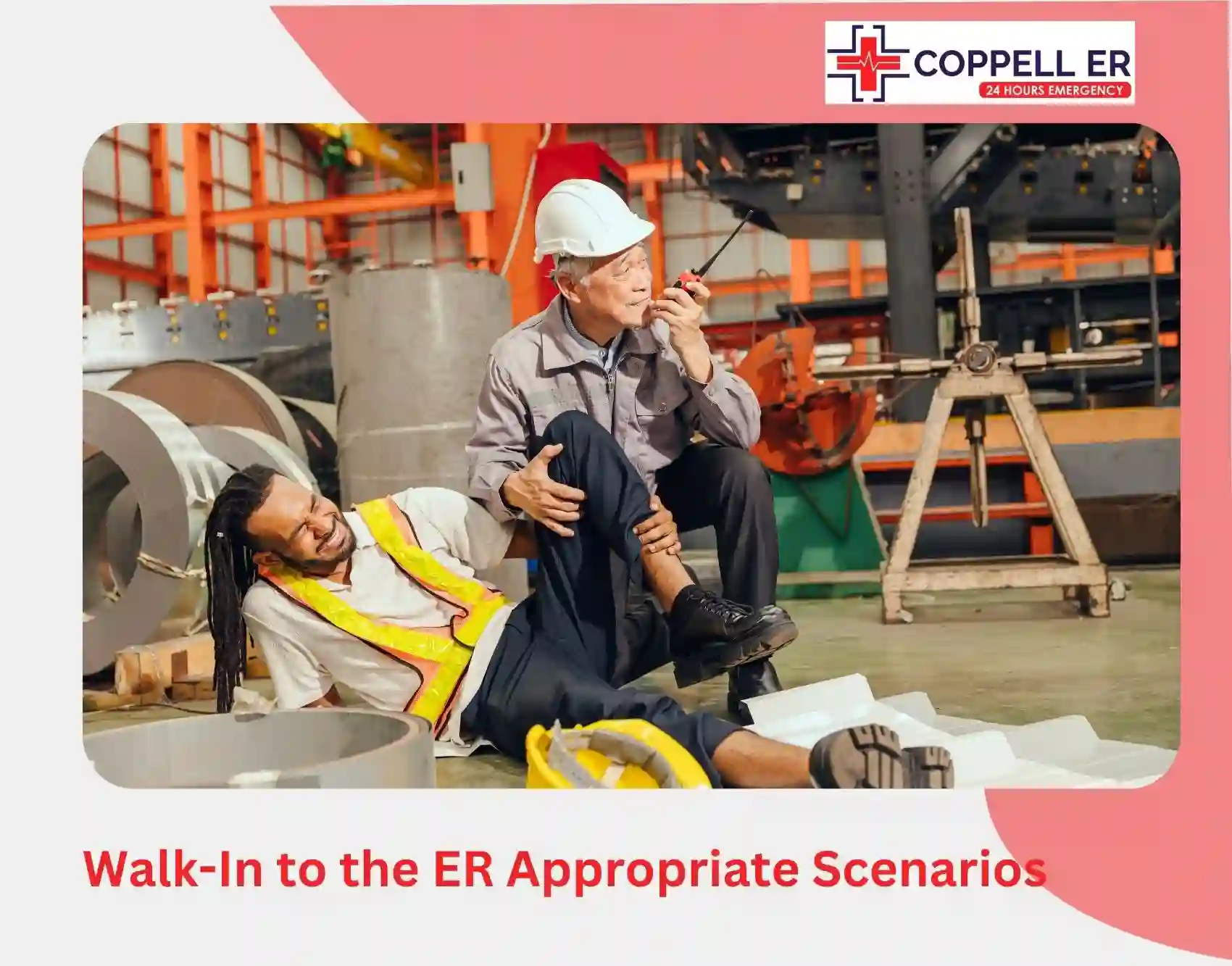
| Driving yourself or being driven to the ER is reasonable for urgent but stable symptoms. Non-severe fractures, deep lacerations with controlled bleeding, mild to moderate breathing concerns, fevers, severe pain without neurological signs, and vomiting that will not stop all fit this walk-in category. |
These scenarios can usually be driven to the ER rather than requiring 911:
- Fractures and sprains with controlled pain and intact circulation to the limb
- Deep cuts needing stitches when direct pressure stops the bleeding
- High fever in a stable adult or older child who can be transported comfortably
- Severe but stable abdominal pain without signs of shock, bleeding, or rigidity
- Mild to moderate asthma attack responding partially to rescue inhaler
- Severe headache in a known migraine sufferer with familiar pattern
- Persistent vomiting or diarrhea causing moderate dehydration
- Minor to moderate burns smaller than the palm of the hand
- Allergic reactions with hives but no swelling of the face, lips, or throat
- Minor head bumps in alert, oriented adults without vomiting, confusion, or memory loss
Why Calling 911 Can Save Critical Minutes
| Paramedics do more than drive fast. They begin treatment at the scene, perform EKGs, give oxygen, start IV lines, and alert the ER before arrival so the right team is waiting. For heart attack, stroke, and major trauma, these pre-arrival minutes often change the outcome. |
A 911 call delivers advantages that driving yourself cannot:
Treatment starts on the way. Paramedics give aspirin for suspected heart attack, oxygen for breathing problems, IV fluids for shock, and epinephrine for severe allergic reactions, often before the ambulance moves.
Advance notice to the ER. Dispatch alerts the receiving facility, which activates the stroke team, cardiac catheterization lab, or trauma team so no time is lost on arrival.
Hands-free hands. The driver can focus on the road while paramedics focus on the patient. Driving yourself with a chest-pain or stroke patient creates two risks instead of one.
Priority routing. Ambulances get traffic law exemptions and route-planning assistance, cutting travel time dramatically compared to a stressed driver in rush hour.
The MedlinePlus heart attack first aid guidance emphasizes that calling 911 at the first sign of heart attack brings treatment faster than driving, since paramedics are trained to begin life-saving care immediately.²
When to Call 911 vs Go to ER as a Parent
| For children, the question of when to call 911 vs go to er shifts even more toward 911 for serious scenarios. Babies turning blue, seizures, severe breathing distress, unresponsiveness, major trauma, and suspected poisoning in children all warrant paramedics rather than a car drive. |
Parent-specific scenarios where 911 is the right call every time:
- Baby or child turning blue around the lips, face, or fingertips
- Child having a seizure, especially a first-time seizure
- Baby or child who cannot be woken up or is extremely limp
- Severe breathing distress with retractions, grunting, or inability to speak
- Suspected swallowing of medications, chemicals, batteries, or small magnets
- Choking that will not clear with back blows or Heimlich maneuver
- Serious injury from a fall from height, car accident, or major impact
- Severe allergic reaction with facial swelling or breathing changes
For non-life-threatening pediatric emergencies, walk-in evaluation at our pediatric emergency care center provides same-visit answers without the hospital ER wait. For life-threatening situations, call 911 first and we will coordinate ambulance arrival.
What Coppell ER Does When You Arrive
| Walk in or arrive by ambulance, Coppell ER begins evaluation within minutes. Board-certified physicians, continuous monitoring, and on-site CT, X-ray, and lab make us ready for both walk-in urgent cases and 911 transports. Ambulance arrivals get coordinated handoff with no triage queue. |
The Coppell ER arrival workflow:
- Immediate triage at our 24-hour emergency room in your neighborhood, with no appointment and no hospital-style wait queue
- Direct physician evaluation by board-certified emergency physicians trained in both life-threatening resuscitation and urgent walk-in care
- Continuous cardiac, oxygen, and blood pressure monitoring from arrival through discharge or transfer
- On-site CT, X-ray, ultrasound, echocardiography, and comprehensive blood work with results in minutes
- Immediate treatment including oxygen, IV fluids, pain management, cardiac medications, and blood products when needed
- Rapid coordination with cardiology, neurology, surgery, or critical care when hospital-level intervention is required
- Discharge home with written instructions, or stabilized transfer with all records transmitted ahead of the receiving hospital
For non-emergency questions before an ER decision, contact the Coppell ER team at 469-763-3136. For symptoms that could be life-threatening, call 911 immediately.
Frequently Asked Questions
Is it faster to call 911 or drive yourself to the ER?
For most life-threatening emergencies, 911 is faster because paramedics start treatment at the scene and the ER prepares before you arrive. Driving is faster only for urgent but stable conditions where no immediate treatment is needed en route.
Can I take an Uber or Lyft to the ER instead of 911?
For stable urgent symptoms, yes. For life-threatening symptoms, no. Rideshare drivers are not trained to help if the condition worsens, and they lack the equipment, monitoring, and legal priority of an ambulance.
Does calling 911 cost more than driving to the ER?
Ambulance transport has its own bill separate from ER care, and costs vary by insurance. But for true emergencies, the cost of not calling, including permanent disability or death, far outweighs the financial difference. Never let cost delay a 911 call.
Will 911 bring me to a specific hospital or ER?
Paramedics typically transport to the nearest appropriate facility, though they may route to specialty centers for stroke, trauma, or heart attack. You can state a preference, but patient stability and specialty needs take priority over location preference.
What should I tell the 911 dispatcher when I call?
State the emergency, your exact location, the person’s age and condition, and any known medical history or medications. Stay on the line, follow the dispatcher’s instructions, and do not hang up until told to.
A Coppell Freestanding ER for Walk-Ins and Ambulance Arrivals, Open 24/7
Coppell ER is a freestanding emergency room open 24 hours a day, seven days a week, serving families across Coppell, Lewisville, Grapevine, Irving, Flower Mound, and Valley Ranch. Board-certified emergency physicians. On-site CT, X-ray, ultrasound, and full lab. No appointment needed. No long waiting room delays. Walk-in care for urgent but stable symptoms, and full coordination with ambulance arrivals for life-threatening emergencies.
Coppell ER | Open 24/7 | Freestanding Emergency Room
720 N Denton Tap Rd, Coppell, TX 75019 | 469-763-3136
Most commercial insurance accepted. In-house billing. No surprise billing. For life-threatening emergencies, dial 911 first.