Reviewed by the Coppell ER pediatric emergency care team
| 🚨 Call 911 or Come to Coppell ER Right Now If
Baby under 3 months with any fever of 100.4°F or higher. Trouble breathing, blue lips, or gasping. Seizure. Not waking up or extreme drowsiness. Stiff neck or purple rash that does not fade under pressure. Not urinating or crying without tears. Repeated vomiting. Do not drive if the child is seriously ill. Coppell ER is at 720 N Denton Tap Rd. Phone: 469-763-3136. |
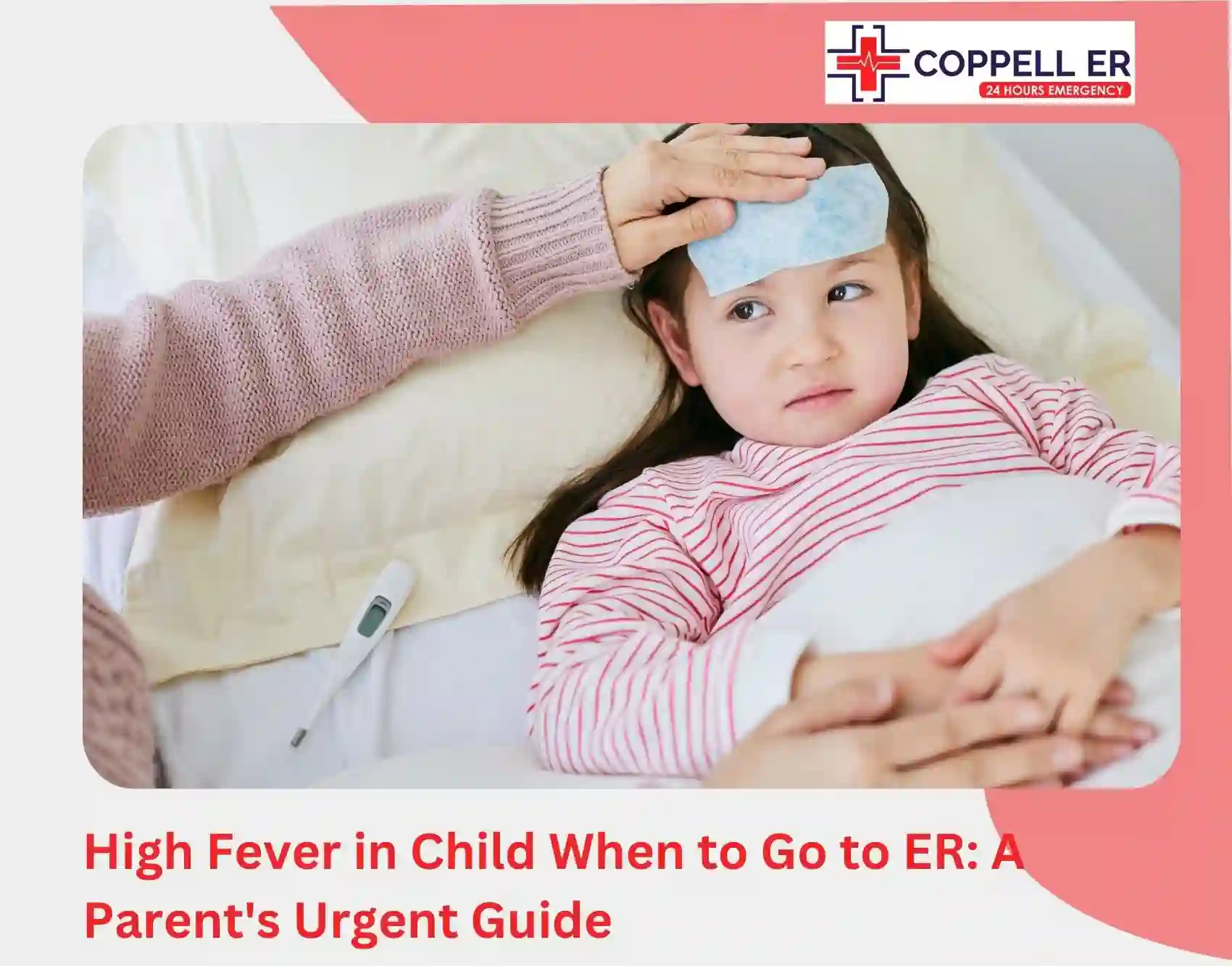
High fever in child when to go to er is one of the most anxious questions Coppell area parents face, particularly late at night when the pediatrician’s office is closed. Most childhood fevers signal a fight against a common infection and pass within a few days. But some fevers, particularly in babies under three months, hint at a serious infection that needs urgent evaluation. Knowing the age-based rules and behavior signs helps you decide when a freestanding ER walk-in is the right next step.
Coppell ER serves families across Coppell, Lewisville, Grapevine, Irving, Flower Mound, and Valley Ranch as a freestanding emergency room with a dedicated pediatric care team, on-site imaging and lab, and no long waiting rooms. When your child is running a fever after hours, walking in for evaluation is often faster than waiting for a same-day pediatrician slot.
Newborns and Babies Under 3 Months

| For babies under three months old, any rectal temperature of 100.4°F or higher is treated as an emergency, no matter how well the baby appears otherwise. Immune systems in this age group are too immature to fight off serious infections reliably, and bacterial illness can progress within hours. |
The rules for the youngest babies are the strictest in medicine. Even in a baby who looks comfortable and is feeding normally, a fever at this age can be the first sign of a serious bacterial infection such as urinary tract infection, bloodstream infection, or meningitis.
| 📏 The Universal Rule for Babies Under 3 Months
Any fever at or above 100.4°F (38.0°C) taken rectally means a call to your pediatrician immediately, and the ER after hours. Do not wait to see if it resolves. Do not give fever reducers before evaluation. This age group requires blood work, urine testing, and sometimes spinal fluid testing to identify the source of the fever. |
According to the American Academy of Pediatrics HealthyChildren.org guidance, newborn fever always warrants same-day evaluation, and after-hours symptoms belong in an ER rather than a wait-until-morning approach.
Babies 3 to 12 Months
| Babies from three to twelve months old need evaluation when the rectal temperature reaches 102.2°F or higher, when fever lasts more than 24 hours, or when it appears alongside any warning signs. Immune systems are still developing, and serious infection risk remains higher than in older children. |
At this age, thermometer number matters more than in newborns, but concerning patterns still trigger ER care:
Rectal temperature at or above 102.2°F. Reaches the threshold where evaluation is recommended even without other warning signs.
Fever lasting more than 24 hours. Persistent fever in this age group needs a doctor to identify the source.
Fever with poor feeding. Refusing feeds or taking less than half the usual amount, particularly over several feedings, is a red flag.
Fever with fewer wet diapers. Less than four wet diapers a day suggests dehydration and warrants evaluation.
Fever with unusual sleepiness or fussiness. A baby who is much harder to console than usual, or who is difficult to wake, needs to be seen.
Fever after recent hospital care or surgery. Post-procedure fever raises the risk profile and warrants prompt evaluation.
Toddlers From One to Three Years
| Toddlers from one to three years old are the group where behavior matters as much as the fever number. A child who is playing, drinking, and interacting normally with a 103°F fever is usually less concerning than a child who looks glassy-eyed and limp with a 101°F fever. Emergency care depends on both. |
The toddler years are when parents can start using overall demeanor as a guide, alongside the thermometer. Watch for these signs regardless of the temperature reading:
- Extreme lethargy, or a child who is much harder to rouse than usual
- Refusing all fluids for more than a few hours, particularly with vomiting
- Signs of dehydration such as no wet diaper for eight hours, no tears when crying, or a dry mouth
- A rash that appears with the fever, especially one that does not fade when pressed
- Difficulty breathing, unusual chest movement, or grunting sounds
- Complaints of severe headache, stiff neck, or sensitivity to light
- A child who cannot be comforted no matter what you try
- Fever lasting more than three days without an obvious source
Our dedicated pediatric emergency care team uses toddler-specific evaluation protocols, since neurological and behavioral assessment differs significantly for this age group.
Children Age Four and Older

| Older children with fever can usually be watched at home when they are playing, drinking, and interacting reasonably well. Emergency care becomes appropriate when behavior changes dramatically, when symptoms suggest a specific serious infection, or when fever persists beyond three or four days without improvement. |
Older children handle fevers better and are able to communicate how they feel. Use these guides:
The behavior test is the most useful home tool. A child who is talking, engaging, and drinking is usually recovering well even with a 103°F reading. A child who looks pale, glassy-eyed, and limp needs to be seen, even with a lower fever.
Serious infection signs deserve immediate attention: severe headache with stiff neck or light sensitivity, breathing difficulty, chest or abdominal pain, persistent vomiting, or a rash that does not blanch when pressed.
Duration matters. A fever lasting more than three days in an older child, or a fever that improves then returns, warrants evaluation to identify the source.
High Fever in Child When to Go to ER: The Universal Warning Signs
| Some symptoms make high fever in child when to go to er a decision that does not depend on age or thermometer number. Difficulty breathing, seizures, a purple rash that does not fade under pressure, dehydration, extreme lethargy, or stiff neck all warrant immediate ER evaluation for any child. |
These universal warning signs override age-based thresholds. If any of them appear alongside a fever in a child of any age, come in immediately:
- Difficulty breathing, rapid breathing, retractions between ribs, or bluish lips
- Seizure of any duration, even brief
- Extreme drowsiness or an inability to fully wake the child
- Stiff neck, severe headache, or unusual sensitivity to light
- A rash that appears with the fever, particularly one that does not fade when a glass is pressed against it
- Signs of dehydration including no urine for eight hours, no tears when crying, sunken eyes, or a dry mouth and tongue
- Persistent vomiting or the inability to keep down any fluids
- Severe abdominal pain that does not resolve
- Confusion, delirium, or hallucinations during fever
- Fever in a child with a weakened immune system, cancer treatment, or recent hospitalization
The CDC’s guidance on sepsis lists many of these same signs as warnings that infection may have progressed beyond a routine illness into a life-threatening state, particularly in children whose immune systems can shift quickly.
What Coppell ER Does for a Feverish Child

| Evaluation at Coppell ER begins within minutes of walk-in, with pediatric-experienced physicians, on-site lab work, and imaging when needed. Coppell area families can walk in without an appointment, day or night, for the peace of mind of a same-visit answer about whether their child needs urgent treatment or safe home care. |
The typical pediatric fever workup follows this sequence:
- Immediate triage without appointment by our board-certified emergency physicians and pediatric-experienced care team
- Focused examination of the ears, throat, chest, abdomen, and skin to identify the source of infection
- Vital signs including temperature, heart rate, breathing rate, and oxygen saturation
- Blood work when needed, including complete blood count and infection markers
- Urine testing for babies under two years old with unexplained fever
- Chest X-ray when respiratory symptoms suggest pneumonia
- Rapid strep, flu, or COVID testing when indicated
- IV fluids for dehydration when the child cannot keep down oral fluids
- Clear written home instructions with warning signs to watch for after discharge
For questions before walking in with a feverish child, or to confirm hours and directions from your Coppell neighborhood, contact us directly. Feel free to call or message the Coppell ER team at 469-763-3136 any time of day or night.
Frequently Asked Questions
What is considered a high fever in a child by age?
For babies under 3 months, any temperature at or above 100.4°F. For infants 3 to 12 months and toddlers, 102.2°F or higher is a threshold. School-age children reach concerning territory around 103°F, though behavior matters more than the number.
Should I bring my baby to the ER at night for a fever?
Yes for any fever in a baby under three months, and for babies 3 to 12 months with a fever of 102.2°F or higher or with warning signs. Coppell ER is open 24 hours a day so nights and weekends are treated the same as any other time.
Are febrile seizures dangerous?
Most simple febrile seizures last under five minutes and do not cause permanent damage. But every first-time febrile seizure warrants ER evaluation to confirm the diagnosis and rule out more serious causes such as meningitis or brain infection.
Can teething cause a high fever?
Teething can cause a slight temperature rise but not a true high fever. A temperature above 101°F should not be blamed on teething. Look for another cause and consider ER evaluation if warning signs appear.
How do I know if my child’s fever is a serious infection?
Serious infection signs include extreme lethargy, difficulty breathing, a rash that does not fade under pressure, stiff neck, severe headache, dehydration, or a child who cannot be consoled. Any of these with fever warrants immediate ER care.
A Coppell Freestanding ER for Your Family, Open 24/7
Coppell ER is a freestanding emergency room open 24 hours a day, seven days a week, serving families across Coppell, Lewisville, Grapevine, Irving, Flower Mound, and Valley Ranch. Board-certified emergency physicians. Pediatric-experienced care team. On-site lab and imaging. No appointment needed. No long waiting room delays. When your child is running a high fever and you need answers now, walk in for the peace of mind of same-visit care.
Coppell ER | Open 24/7 | Freestanding Emergency Room
720 N Denton Tap Rd, Coppell, TX 75019 | 469-763-3136
Most commercial insurance accepted. In-house billing. No surprise billing.