
Reviewed by the Coppell ER emergency care team
| 🚨 Call 911 If Back Pain Comes With Any of These
Loss of bladder or bowel control. Numbness in the groin, inner thighs, or buttocks. Sudden weakness in both legs. Severe tearing pain in the back or abdomen. Fever with severe back pain. Pain after a fall from height, car crash, or major impact. Do not drive if these signs are present. Coppell ER is at 720 N Denton Tap Rd. Phone: 469-763-3136. |
Back injury when to seek emergency care is one of the trickier questions in medicine because most back pain resolves on its own, while a small percentage signals a spinal cord problem, cauda equina syndrome, spinal fracture, or something completely different disguised as back pain. Emergency physicians rely on specific red flag signs from other parts of the body to sort the two apart. Knowing those signs lets you decide whether a freestanding ER walk-in makes sense right now.
A freestanding emergency room like Coppell ER provides the same board-certified physicians and on-site imaging as a hospital ER, without the multi-hour wait, which matters when back pain patterns suggest cauda equina or spinal cord compression that has a treatment window measured in hours.
What Your Legs Are Doing
| Back pain paired with sudden weakness, numbness, or loss of function in one or both legs is a neurological emergency. Foot drop, difficulty walking, or a leg that gives out under weight all suggest nerve compression that needs urgent imaging and treatment before damage becomes permanent. |
The nerves affected by a serious back injury exit through the spine and travel down the legs. Emergency physicians watch for these specific leg signs when evaluating back pain:
- Sudden weakness in one or both legs that was not present before the injury
- Numbness or a pins-and-needles sensation that spreads down the leg or into the foot
- Foot drop, an inability to lift the front of the foot when taking a step
- A leg that gives way or buckles under body weight
- Progressive worsening of leg symptoms over hours or days
- Loss of reflexes in the knee or ankle that a doctor can check on exam
- Difficulty walking, frequent falls, or trouble with balance
The American Academy of Orthopaedic Surgeons OrthoInfo library lists progressive neurological deficits as a clear indication for urgent evaluation rather than watchful waiting at home.
What Your Bladder, Bowel, and Saddle Area Are Doing

| The single most urgent back pain warning sign is cauda equina syndrome. New difficulty urinating, loss of bladder or bowel control, or numbness in the groin and inner thighs point to nerve compression at the base of the spinal cord. Treatment within 48 hours is critical. |
These specific signs override any assumption that back pain will resolve on its own. Any one of them warrants immediate ER evaluation:
New difficulty starting urination. Cauda equina compression often shows first as urinary retention, an inability to fully empty the bladder.
Loss of bladder control. New leaking or an inability to hold urine, particularly with back pain, is a hallmark warning sign.
Loss of bowel control. Fecal incontinence or the inability to feel a bowel movement coming, combined with back pain, needs immediate attention.
Saddle numbness. Reduced feeling in the inner thighs, groin, genitals, or the area around the anus, as if you were sitting on a numbed cushion.
New sexual dysfunction. Sudden loss of sexual function alongside back pain can indicate cauda equina compression.
| ⏱ Why the 48-Hour Window Matters
Cauda equina syndrome causes progressive nerve damage that becomes permanent without decompression, usually surgical, within about 48 hours of symptom onset. Recovery of bladder, bowel, and sexual function drops significantly with each hour of delay. If any of the above signs appear alongside back pain, go to the ER, not a primary care appointment tomorrow. |
What Your Fever, Weight, and Overall Health Are Doing
| Back pain plus fever, unexplained weight loss, night sweats, or a recent infection anywhere in the body raises suspicion for spinal infection or cancer spread to the spine. These systemic warning signs often appear before neurological problems and need urgent imaging to identify the cause. |
Systemic symptoms alongside back pain tell emergency physicians to look for something beyond a muscle strain. Concerning patterns include:
- Fever, chills, or night sweats with back pain, suggesting possible spinal infection or vertebral osteomyelitis
- Unexplained weight loss over the past weeks or months, which can indicate spinal spread of cancer
- A personal history of cancer, particularly breast, lung, prostate, kidney, or thyroid, since these can spread to the spine
- Recent bloodstream infection, dental work, IV drug use, or recent spine procedure
- Immune suppression from steroids, chemotherapy, HIV, or organ transplant
- Pain that wakes you from a sound sleep, or pain that persists at rest and is not relieved by position changes
- Pain lasting more than six weeks without any improvement
When the Back Pain Isn’t Actually Your Back
| Some conditions that feel like back pain are actually organ emergencies. A tearing pain radiating to the back can be aortic dissection. Severe flank pain with blood in urine can be a kidney stone or infection. Pain paired with abdominal symptoms may point to internal organs rather than the spine itself. |
These conditions can present as back pain but require completely different evaluation and treatment:
Abdominal aortic aneurysm or dissection. A sudden, severe, tearing pain in the mid or lower back, sometimes with a pulsating sensation in the abdomen, can indicate a weakening or tearing of the body’s main artery. This is a life-threatening emergency, particularly in adults over 60.
Kidney stone or infection. Severe pain in the flank area that comes in waves, often with blood in the urine, nausea, or fever, is typically kidney-related rather than a spine problem. Kidney infections can progress to bloodstream infection quickly.
Pancreatitis or gallbladder disease. Upper abdominal pain that radiates to the back, especially after eating, may signal pancreatic or gallbladder problems that can become emergencies when severe.
Heart attack. In some cases, particularly in women, older adults, and diabetics, a heart attack can present with upper back pain rather than the classic chest pain, often paired with shortness of breath, sweating, or nausea.
The MedlinePlus guide on acute low back pain confirms that emergency evaluation is warranted whenever back pain is accompanied by neurological symptoms, systemic signs of illness, or features suggesting the pain may not be spinal in origin.
Back Injury When to Seek Emergency Care for Higher-Risk People
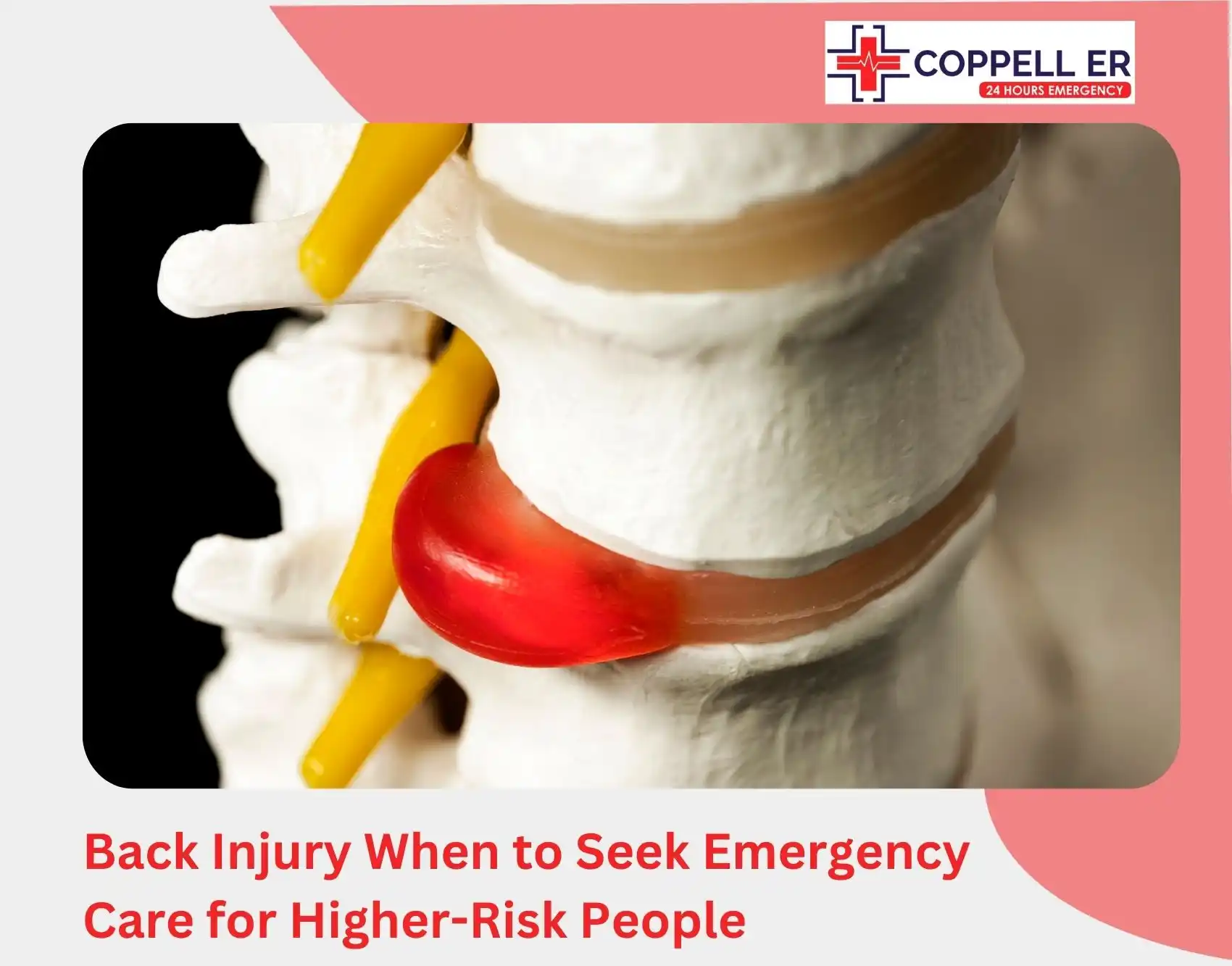
| Adults over 65, people on blood thinners, those with osteoporosis, patients with cancer or immune suppression, and anyone with recent trauma face elevated risks from back injuries. In these groups, when to seek emergency care for back injury shifts firmly toward earlier evaluation with lower thresholds for imaging. |
The same back pain carries very different risk levels depending on who has it. These groups deserve immediate ER care for symptoms that might otherwise be watched at home:
- Adults over 65, particularly after a fall, since vertebral compression fractures can occur with minimal force
- Anyone who sustained back pain after a fall from height or hard landing, since our fall and trauma emergency team performs on-site imaging to check for spinal injury
- People on blood thinners, since even minor spinal injury can cause bleeding around the spinal cord
- Anyone with osteoporosis, whose spinal bones can fracture from minimal trauma or even routine activity
- Patients with a history of cancer, particularly if the cancer type commonly spreads to bone
- Anyone with long-term steroid use, which weakens vertebrae and raises fracture risk
- People with immune suppression from HIV, chemotherapy, or organ transplant, since infection risk is elevated
- Anyone with IV drug use history, given the higher risk of spinal epidural abscess
What Coppell ER Does for a Suspected Serious Back Injury

| Evaluation at Coppell ER begins within minutes of walk-in. A board-certified emergency physician performs a focused neurological exam, checks vital signs and reflexes, and orders imaging when indicated. Most patients receive a working diagnosis and treatment plan within about an hour of arrival. |
The typical workup follows this sequence:
- Rapid triage without appointment by an emergency physician with acute back injury expertise
- Focused neurological exam checking motor strength, sensation, reflexes, and gait
- Vital signs, urinalysis, and blood work when infection or systemic illness is suspected
- On-site CT scan of the spine and abdomen when fracture, bleeding, or non-spinal causes are suspected
- MRI referral for suspected cauda equina syndrome, spinal cord compression, or spinal infection
- Pain management and immediate stabilization while diagnostic workup continues
- Direct coordination with neurosurgery, orthopedic spine surgery, or vascular surgery when urgent intervention is needed
For questions before walking in with a back injury, or to confirm hours and location, contact our Coppell ER team directly. As a freestanding emergency room, we are open 24 hours a day every day of the year, staffed with the same board-certified emergency physicians and equipped with the same imaging as a hospital ER, without the waiting room.
Frequently Asked Questions
What is the difference between muscle strain and serious back injury?
Muscle strain causes localized pain that improves with rest and worsens with specific movements. Serious back injury tends to come with neurological signs like leg weakness, bladder changes, or persistent pain unrelieved by position changes or rest.
What is cauda equina syndrome and how urgent is it?
Cauda equina syndrome is compression of the nerves at the base of the spinal cord. It causes bladder and bowel changes, saddle numbness, and leg weakness. Treatment within 48 hours is critical to prevent permanent damage.
Should I go to the ER for back pain after a fall?
Yes if any of these apply: severe pain, numbness or weakness in the legs, difficulty walking, blood in urine, or if you are over 65, on blood thinners, or have osteoporosis. Imaging is warranted to rule out fracture.
Can severe back pain be a heart attack or aortic problem?
Yes. Aortic dissection produces sudden tearing back pain, often with shortness of breath or a pulsating abdomen. Some heart attacks, particularly in women and diabetics, present as upper back pain with sweating, nausea, or shortness of breath.
When is back pain with numbness an emergency?
Immediately if numbness affects both legs, the saddle area (groin, inner thighs, buttocks), or comes with bladder or bowel changes. Numbness that spreads or progresses over hours also warrants urgent evaluation, even without other symptoms.
Fast Answers for Back Injury When Time Matters
Back injuries do not follow business hours, and neither do we. Coppell ER is a freestanding emergency room open 24 hours a day, with board-certified physicians, on-site CT imaging, and no appointment required. Walk in, get evaluated fast, and get clear answers about whether that back pain needs urgent care or can be managed at home.
Coppell ER | Open 24/7 | Freestanding Emergency Room
720 N Denton Tap Rd, Coppell, TX 75019 | 469-763-3136
Most commercial insurance accepted. In-house billing. No surprise billing.
External Refrences Links :
1.American Academy
2.MedlinePlus guide