Reviewed by the Coppell ER pediatric emergency care team
| 🚨 Call 911 or Head to Coppell ER Right Now If Your Child Has
A rash that does not fade when pressed with a clear glass. A purple or dark red pinpoint rash with fever. Stiff neck or severe headache with the rash. Breathing difficulty, swelling of face or tongue. Extreme sleepiness or confusion. A rapidly spreading rash with high fever. Coppell ER is at 720 N Denton Tap Rd. Phone: 469-763-3136. |
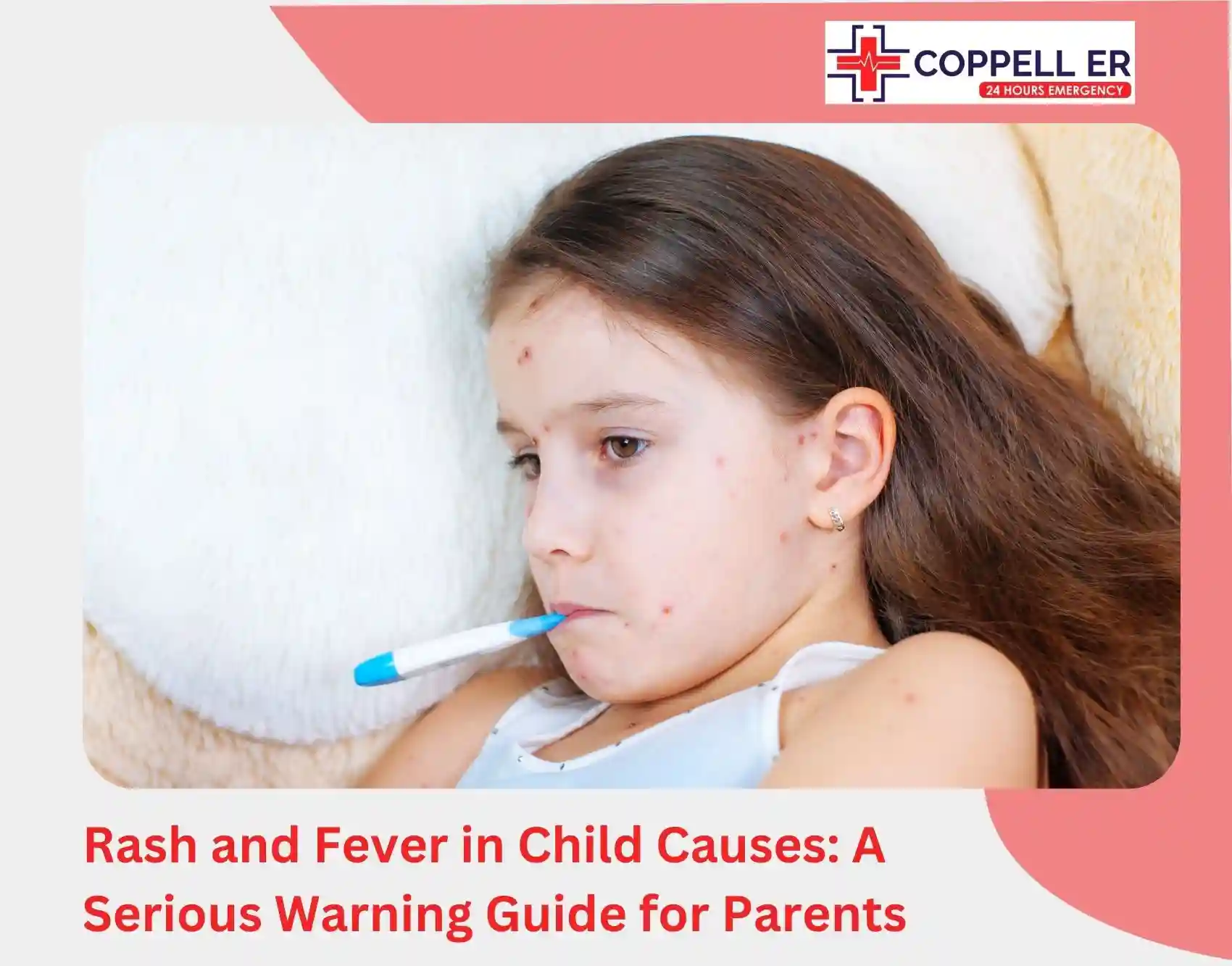
Rash and fever in child causes range from mild viral illnesses that pass in a week to life-threatening bacterial infections that can turn deadly within hours. Most pediatric rashes paired with fever are harmless viral exanthems. But a small percentage signal meningococcal disease, scarlet fever, Kawasaki disease, or severe allergic reactions that need urgent evaluation. Knowing which rash patterns demand immediate care is one of the most protective skills a Coppell area parent can learn.
This visual decoder, built for Coppell, Lewisville, Grapevine, Irving, Flower Mound, and Valley Ranch families, serves as a quick-reference guide alongside walk-in access to the Coppell ER pediatric emergency team, a freestanding emergency room open 24 hours a day with same-visit lab testing and board-certified physicians.
| 🔍 The Glass Test: The Single Most Important Thing to Learn
Press the side of a clear glass firmly against the rash. If the rash fades or disappears under the glass, it is called a blanching rash and is usually less urgent. If the rash stays visible through the glass without fading, it is a non-blanching rash and may indicate bleeding under the skin from meningococcal disease, severe infection, or clotting problems. A non-blanching rash with fever is a 911 call. Do not wait to see if it changes. |
What the Rash Pattern Tells You
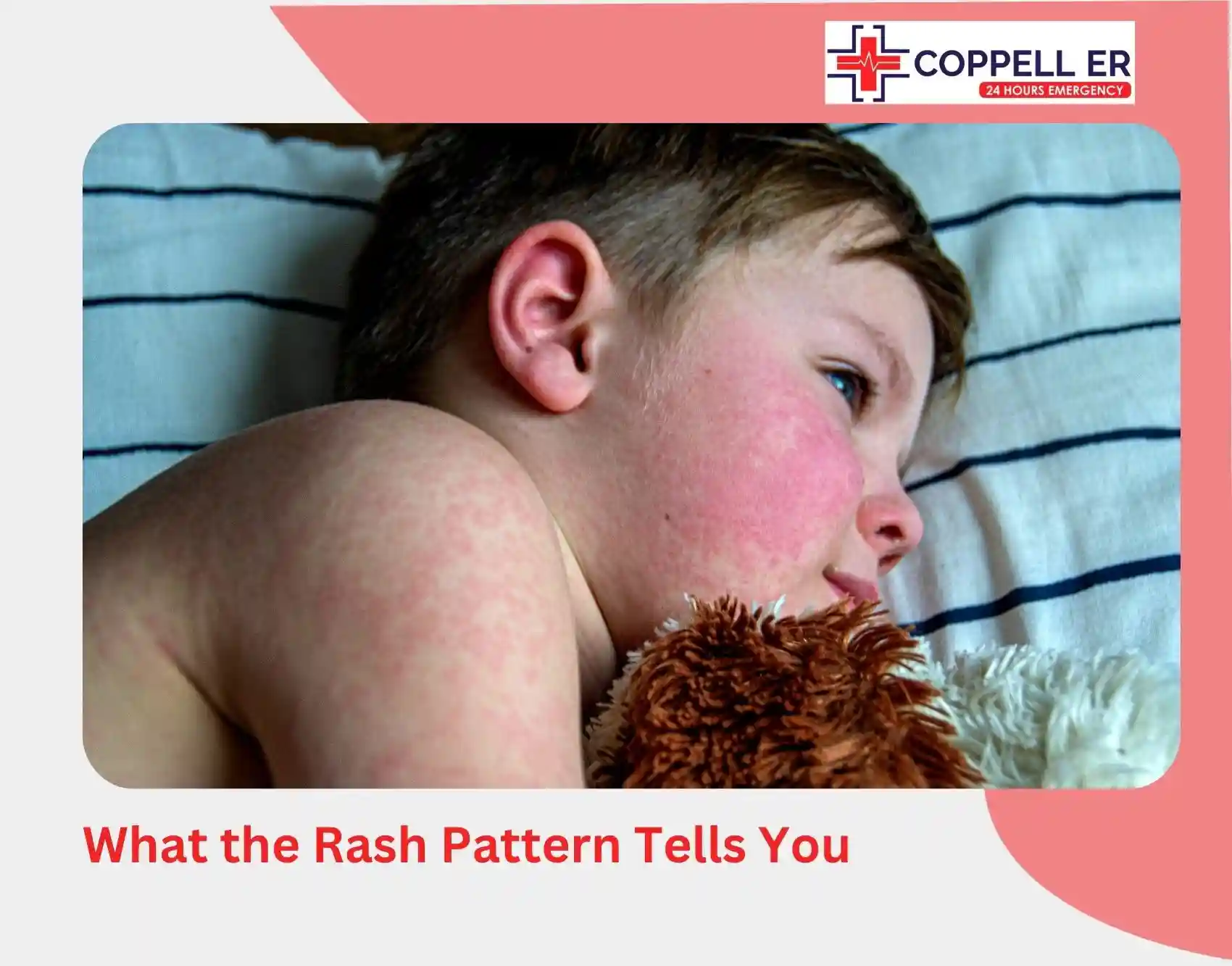
| The appearance of the rash often points directly to the cause. Flat pink patches suggest viral illness. Pinpoint purple spots suggest a bleeding problem or meningococcal disease. Raised blisters suggest varicella. Sandpaper-feel red rash suggests scarlet fever. Pattern recognition is step one in rash and fever evaluation. |
Different rash appearances point to different pediatric rash types. Use these pattern descriptions to narrow what you may be looking at:
Flat pink to red patches that blanch. Called macules. Most often indicate a viral exanthem such as roseola, measles, or a non-specific viral rash. Usually self-limiting.
Small raised red bumps that blanch. Called papules. Common with viral illness, allergic reactions, or heat rash. Context and spread pattern help identify the cause.
Pinpoint purple or dark red spots that do not fade under pressure. Called petechiae. Can indicate meningococcal disease, severe strep, or a clotting disorder. A non-blanching rash with fever is urgent.
Larger purple patches that do not blanch. Called purpura. Suggests bleeding under the skin from infection, immune problems, or trauma. Needs evaluation.
Raised itchy welts that come and go. Called hives or urticaria. Allergic reaction. Watch for face or throat swelling, which signals anaphylaxis.
Fluid-filled blisters on red bases. Called vesicles. Classic of chickenpox, hand-foot-mouth, and herpes-type infections. Fever often precedes the blisters.
Fine sandpaper-feeling red rash. The classic texture of scarlet fever, which follows a strep throat infection and needs antibiotic treatment.
Common Viral Rashes That Come With Fever
| A viral rash with fever is the most common combination parents see. Roseola, hand-foot-mouth, chickenpox, fifth disease, and non-specific viral exanthems all follow a similar pattern: fever first, rash second. Most resolve on their own within a week with rest and fluids. |
These common viral causes of rash and fever typically do not require ER care unless warning signs appear:
Roseola. High fever for 3 to 5 days that breaks suddenly, followed by a pink flat rash on the trunk. Usually in babies 6 to 24 months. Rash appears as the fever resolves. Self-limiting.
Hand, foot, and mouth disease. Fever, sore throat, and small red spots or blisters in the mouth and on the hands, feet, and sometimes buttocks. Caused by coxsackievirus. Watch for dehydration from mouth pain.
Chickenpox (varicella). Fever with itchy red spots that become blisters, then crust over. Appears in waves over several days. Less common since widespread vaccination, but still occurs, particularly in unvaccinated children.
Fifth disease. Low fever followed by a bright red slapped-cheek rash and later a lacy rash on the arms and legs. Caused by parvovirus B19. Usually mild, but important to avoid pregnant contacts.
Non-specific viral exanthem. Various unnamed viruses that produce fever and generalized flat or slightly raised pink rash. Comfort care at home is usually enough if the child is drinking, playing, and interacting normally.
The Johns Hopkins Medicine guide to common pediatric rashes emphasizes that most viral exanthems resolve without specific treatment, but any viral-looking rash paired with worsening behavior, breathing problems, or persistent high fever warrants prompt medical evaluation.¹
Bacterial and Emergency Rashes That Need the ER
| Certain rash patterns with fever signal serious bacterial infection or inflammatory conditions that need immediate care. Meningitis rash signs, scarlet fever, Kawasaki disease, toxic shock, and staphylococcal scalded skin syndrome all require urgent evaluation to prevent complications or death. |
These conditions turn the pairing of rash and fever into a true emergency:
Meningococcal disease. A non-blanching pinpoint purple rash paired with high fever, stiff neck, severe headache, or lethargy. Can progress to shock within hours. The glass test is the hallmark screening tool. Call 911 immediately.
Scarlet fever. Sandpaper-feel red rash spreading from the chest outward, with fever, sore throat, and strawberry tongue. Needs antibiotic treatment to prevent rheumatic fever and kidney complications.
Kawasaki disease. Fever lasting more than 5 days with a widespread rash, red eyes, cracked lips, strawberry tongue, red swollen hands and feet, and swollen neck lymph nodes. Can damage the heart’s arteries without treatment within 10 days of fever onset.
Toxic shock syndrome. Sudden high fever, flu-like symptoms, diffuse red sunburn-looking rash, low blood pressure, and confusion. A rare bacterial toxin emergency that progresses rapidly.
Staphylococcal scalded skin syndrome. Fever with red skin that blisters and peels, particularly in young infants. Needs hospital-level treatment with IV antibiotics.
According to Boston Children’s Hospital guidance on meningococcal infections, meningococcal bacterial infection can progress from mild symptoms to septic shock within a single day, which is why any suspicious non-blanching rash with fever warrants immediate ER evaluation.²
Allergic and Immune Reactions That Produce Rash With Fever
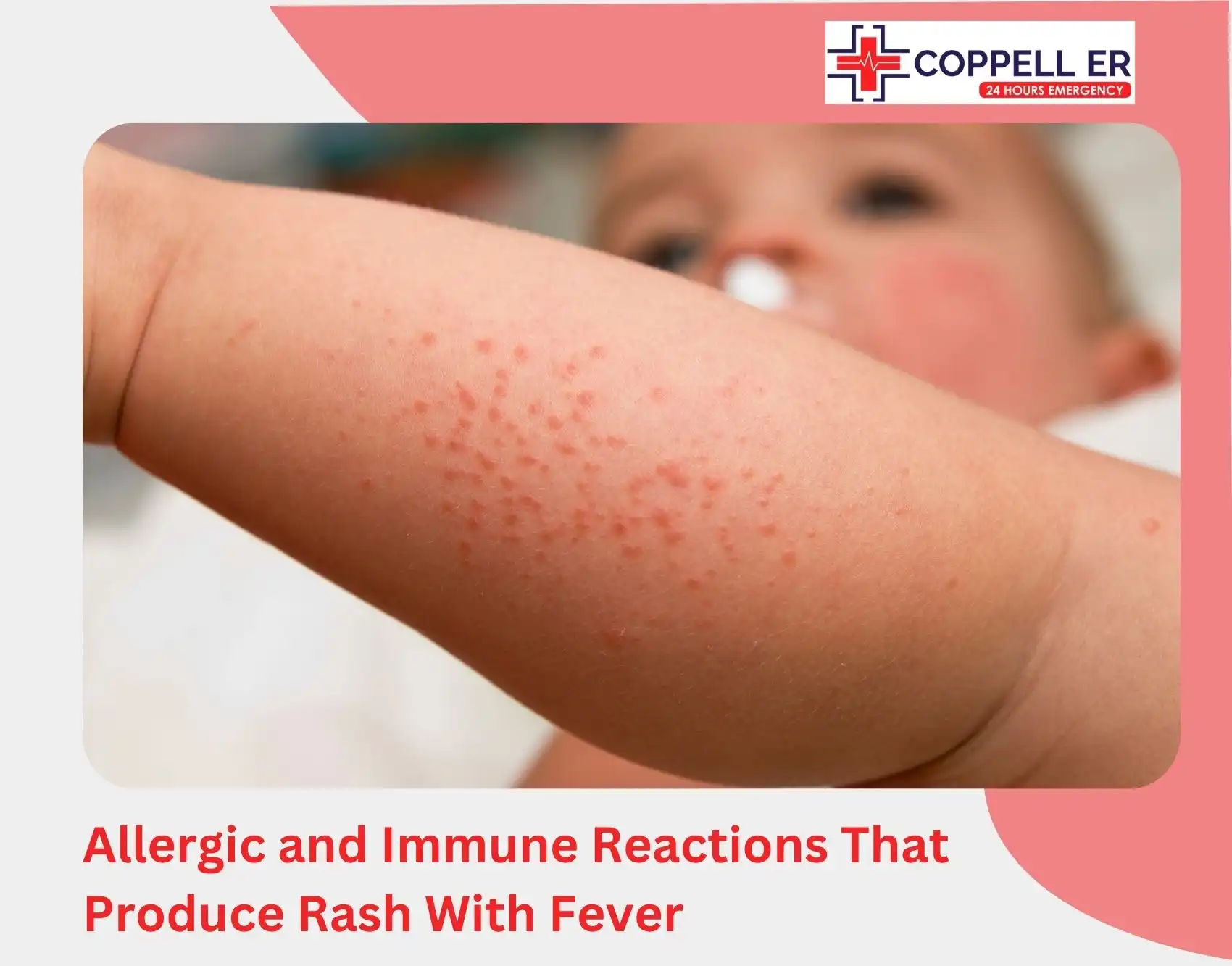
| Not all rashes with fever come from infection. Drug reactions, serum sickness, autoimmune responses, and certain inflammatory conditions can produce the same combination. These usually have specific triggers, patterns, and timing that help distinguish them from infectious causes. |
Immune and allergic conditions worth recognizing include:
- Drug-induced rash with low-grade fever, often appearing days to weeks after starting a new medication
- Serum sickness, where a fever and widespread rash appear 1 to 3 weeks after an infection or new medication exposure
- Severe allergic reaction with hives, fever, and swelling, which can progress to anaphylaxis needing emergency treatment
- Juvenile idiopathic arthritis, where a fine salmon-colored rash appears with fever spikes, particularly in older children
- Stevens-Johnson syndrome, a rare but severe reaction with fever, blistering rash, and mucous membrane involvement that always needs emergency care
- MIS-C (multisystem inflammatory syndrome in children) following COVID-19 infection, with persistent fever, rash, red eyes, and sometimes abdominal pain
Rash and Fever in Child Causes That Need the ER
| Rash and fever in child causes become emergencies when the rash does not blanch, when it spreads rapidly, when breathing becomes difficult, or when the child shows signs of serious infection. Not every rash with fever needs the ER, but certain patterns warrant immediate walk-in evaluation. |
These signs together with any rash and fever combination mean head to the ER immediately:
- A non-blanching rash of any kind that does not fade when pressed with a clear glass
- Rash with stiff neck, severe headache, or extreme sensitivity to light
- Rash with difficulty breathing, swelling of lips or tongue, or wheezing
- Rash with high fever lasting more than 5 days, particularly with red eyes or cracked lips
- Blistering rash that peels large sheets of skin
- Rapidly spreading rash with high fever and lethargy
- Rash with confusion, delirium, or difficulty waking the child
- Any rash with fever in a baby under 3 months
- Rash with fever in a child with cancer, immune suppression, or recent transplant
What Coppell ER Does for a Rash With Fever
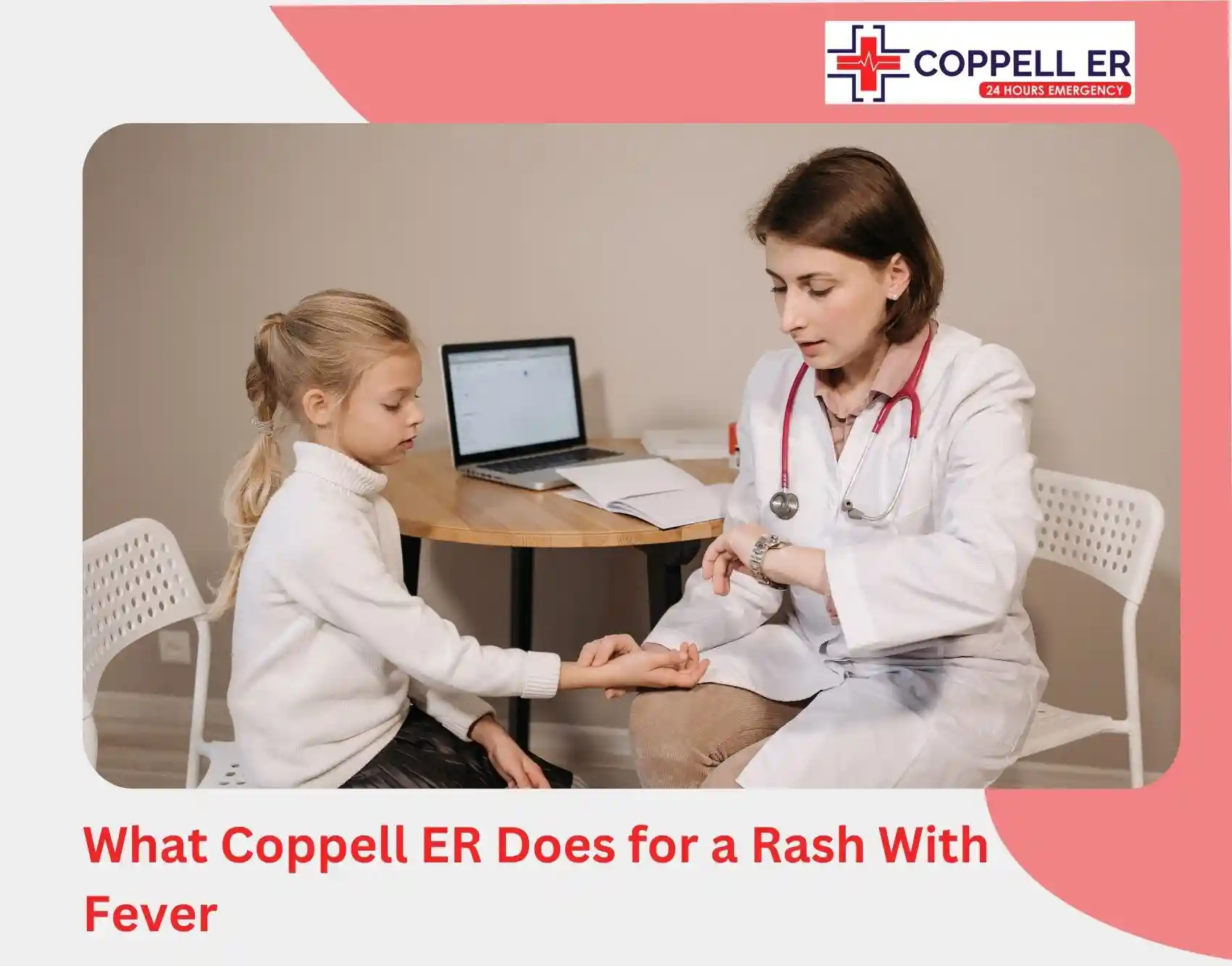
| Evaluation at Coppell ER begins within minutes of walk-in, with pediatric-experienced physicians, full physical examination, and on-site lab testing to distinguish viral from bacterial causes. Coppell area families can walk in day or night for a same-visit answer about whether the rash and fever need urgent treatment or safe home monitoring. |
The typical pediatric rash and fever workup follows this sequence:
- Immediate triage without appointment at our no-wait freestanding emergency room
- Full head-to-toe examination of the rash pattern, distribution, and texture, including the glass test
- Vital signs including temperature, heart rate, breathing rate, and oxygen saturation
- Blood work and rapid testing by our board-certified emergency physicians when bacterial infection or inflammation is suspected
- Rapid strep, flu, or COVID-19 testing when the rash pattern suggests those causes
- IV access and antibiotics when meningococcal disease or sepsis cannot be ruled out quickly
- Observation period with repeated examination when the picture is evolving
- Clear written home instructions with warning signs that should prompt a return visit
For questions before walking in from your neighborhood near the Coppell 24-hour ER, feel free to message the Coppell ER team at 469-763-3136 any time of day or night.
Frequently Asked Questions
What does a meningitis rash look like in a child?
A classic meningitis rash is pinpoint purple or dark red spots that do not fade when pressed with a clear glass. It may spread into larger patches. Paired with fever, stiff neck, or lethargy, it is a 911 emergency.
How do you perform the glass test on a child’s rash?
Press the side of a clear drinking glass firmly against the rash and look through the glass. If the rash stays visible without fading, it is non-blanching and may indicate serious infection. Blanching rashes temporarily disappear under pressure.
Is a viral rash with fever contagious?
Most viral rashes are contagious, particularly before the rash appears. Chickenpox, measles, and fifth disease all spread easily. Keep an affected child home from school or daycare until the pediatrician confirms it is safe to return.
How long does roseola rash last after fever breaks?
The rose-pink roseola rash typically appears as the fever breaks and lasts 1 to 3 days before fading on its own. The child is usually no longer contagious once the rash appears. No specific treatment is needed.
Can a rash and fever be from an allergic reaction?
Yes. Drug reactions, serum sickness, and severe allergic responses can all produce rash with fever. Watch for face or tongue swelling, breathing problems, or hives spreading rapidly, which can signal anaphylaxis needing emergency care.
A Coppell Freestanding ER for Your Family, Open 24/7
Coppell ER is a freestanding emergency room open 24 hours a day, seven days a week, serving families across Coppell, Lewisville, Grapevine, Irving, Flower Mound, and Valley Ranch. Board-certified emergency physicians. Pediatric-experienced care team. On-site lab testing, IV access, and imaging. No appointment needed. No long waiting room delays. When your child has a rash with fever and you need answers now, walk in for the peace of mind of same-visit evaluation.
Coppell ER | Open 24/7 | Freestanding Emergency Room
720 N Denton Tap Rd, Coppell, TX 75019 | 469-763-3136
Most commercial insurance accepted. In-house billing. No surprise billing.
External References Links :
2.Boston Children’s Hospital guidance on meningococcal infections,