
A heart rhythm has to be misbehaving while we are watching for us to name it. By the time most people reach a doctor’s office, the flutter has passed and the tracing looks perfect. Our irregular heartbeat emergency room in Coppell records your rhythm within minutes of arrival and monitors it continuously afterward, not for ten seconds.
No appointment. No long wait. If your heartbeat is racing, skipping, or dragging right now, walk in or call.
Call Now: 469-763-3136
Hours: 24/7/365
Walk-In: Coppell ER | 720 N Denton Tap Rd, Coppell, TX 75019

An occasional skipped beat after strong coffee or a poor night’s sleep is usually nothing. The picture changes when the sensation brings company.
Come in immediately if an irregular heartbeat arrives with:
Palpitations with near-fainting deserve particular weight. Feeling as though you might pass out while your heart misbehaves suggests the rhythm is briefly failing to move enough blood. That combination is one of the higher-risk presentations in emergency medicine, and it is not something to observe from the couch.
If your pulse has simply climbed and stayed there, or has slipped unusually low, our guides explain where the thresholds sit. When symptoms are active, a heart palpitations ER visit answers the question while the answer is still visible.
Here is the frustrating arithmetic of arrhythmias. They come and go. The heart can slip out of rhythm and back again between one appointment and the next, and a recording taken afterward shows a heart behaving impeccably.
That is why the single most useful thing you can do is arrive while it is happening. Not tomorrow, when the flutter has passed and you feel foolish describing it. Now, while the rhythm is still misbehaving and a machine can see it.
An EKG for irregular heartbeat evaluation captures roughly ten seconds of electrical activity. Ten seconds is plenty when the arrhythmia is present. It is worthless when the arrhythmia ended in the parking lot.
People talk themselves out of this constantly. The episode passes, the fear recedes, the visit gets postponed, and the next episode arrives with nobody any wiser. Every postponement discards the only evidence that would have named the problem.
An irregular heartbeat emergency room exists precisely for the hours when a clinic is closed and the rhythm is awake. If your heart is doing something strange as you read this, that is the moment to come.
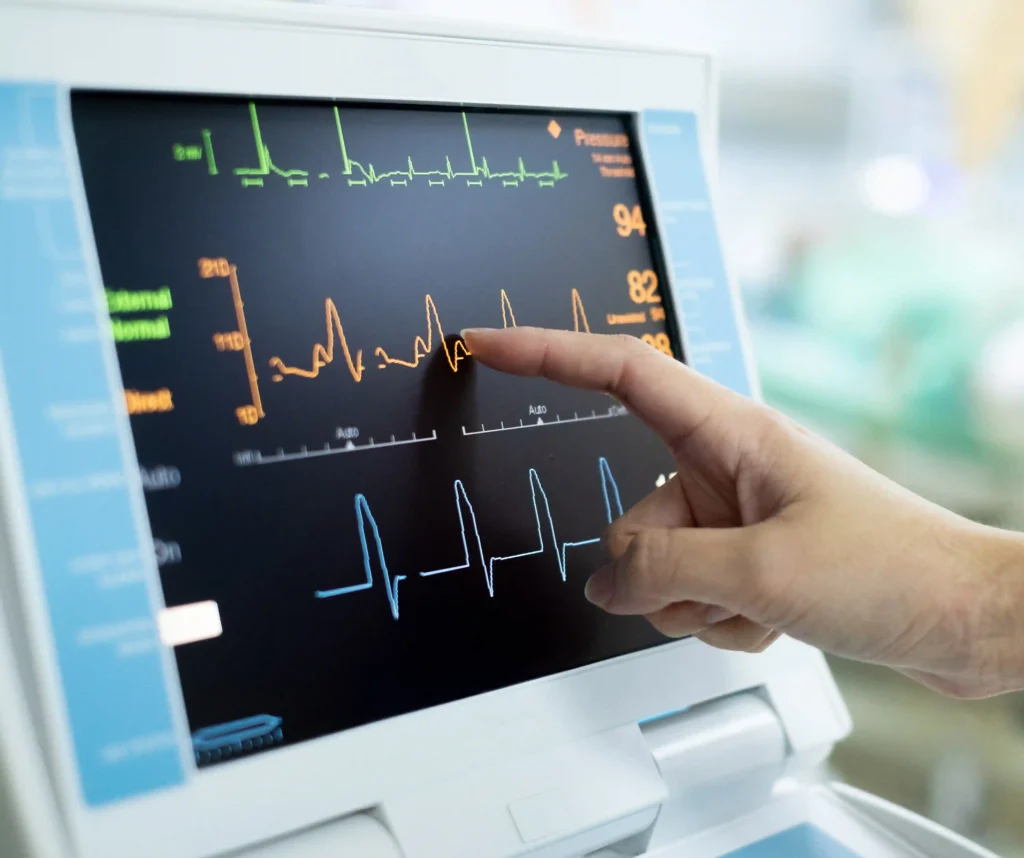

A clean tracing is reassuring. It is not a verdict.
A standard EKG records only the moment it is taken. A normal result means nothing was wrong during that brief window, not that your rhythm is always normal. Cardiologists say this plainly, and it is the reason a single strip rarely closes the case for someone with intermittent symptoms.
What changes the odds is duration. In our irregular heartbeat emergency room you are placed on continuous cardiac monitoring, not handed a ten-second printout. Over the hours of your visit, we watch for the rhythm to reappear, and we watch it live rather than in retrospect.
We also look for what an EKG alone cannot show. Cardiac enzyme testing reveals strain on the heart muscle. Bloodwork uncovers the thyroid disturbance, electrolyte imbalance, or anemia driving the sensation.
When the rhythm still refuses to appear, that is not a dead end either. We coordinate cardiology follow-up for extended ambulatory monitoring, which records over days rather than seconds. The answer gets found. It just needs more time than a clinic visit allows.
Cardiac symptoms move to the front of the line. The clock matters here more than almost anywhere.
Within minutes of arrival:
Rate, rhythm, blood pressure, and oxygen, along with when the sensation began and what it feels like.
Performed immediately, while the rhythm may still be active, and read on the spot by a board-certified emergency physician.
You stay on telemetry throughout, so an episode that returns during your visit is captured rather than described.
Cardiac enzymes, electrolytes, thyroid function, and a blood count, each of which can disturb rhythm.
Your doctor interprets everything together, explains what is driving the beat, and outlines what comes next.
Most patients have an answer within the hour. If the tracing points toward a cardiac event rather than a rhythm disturbance, our heart attack care team is already in the building.
Arrhythmia treatment follows the tracing, because the rhythm dictates the response. There is no universal fix for an irregular heartbeat, and guessing at one is worse than waiting for the reading.
Fast rhythms are slowed with medication given intravenously, so the effect can be titrated and observed rather than hoped for. Some convert on their own once the trigger is addressed.
Slow rhythms call for a different question: what is suppressing the rate. An electrolyte imbalance, a thyroid disorder, an infection, or a medication doing more than intended. Correcting the cause often restores the rate.
Reversible triggers get treated directly. Dehydration, low potassium, fever, and an overactive thyroid each disturb rhythm and each responds to its own correction.
Monitoring continues throughout arrhythmia treatment, because how your heart responds tells us as much as the rhythm you arrived with. When your case calls for ongoing cardiology care or a procedure, we stabilize you and coordinate that referral directly.


Atrial fibrillation is the most common sustained arrhythmia, and its danger has little to do with how it feels.
When the upper chambers quiver rather than beating cleanly, blood pools instead of moving through. Pooled blood clots. A clot that reaches the brain causes a stroke, often long before the palpitations become unbearable.
AFib emergency care therefore looks past the sensation. We identify the rhythm, assess clot risk, stabilize the rate, and coordinate the follow-up that protects you across the years ahead. An irregular heartbeat that turns out to be AFib is precisely the finding that makes an ordinary-seeming visit worth the trip.
Continuous cardiac monitoring throughout your visit, rather than a ten-second strip and a shrug.
Onsite EKG, cardiac enzymes, and full bloodwork under one roof, with no referrals and no waiting days for results.
Most patients reach an exam room within minutes, which matters when the rhythm may not last.
Our doctors separate a benign flutter from a dangerous arrhythmia and act accordingly.
If you need cardiology or extended monitoring, we arrange it directly.
Irregular heartbeat treatment Coppell families can reach at any hour: we accept most major insurance plans and offer flexible payment plans for uninsured patients.
Searching for an irregular heartbeat emergency room near you? Coppell ER sits on North Denton Tap Road and delivers 24/7 cardiac emergency care with onsite EKG, laboratory testing, and continuous rhythm monitoring.
We serve patients from:
No appointment. No excessive wait. Irregular heartbeat treatment Coppell residents can reach while the rhythm is still happening, open day and night, holidays included.


Rhythms wake people at three in the morning. They arrive during a quiet dinner and vanish before the check comes.
If your heart is doing something it has never done, do not wait for it to stop so you can describe it later. Walk in while it is happening, and let us see it for ourselves.
Call Now: 469-763-3136
Hours: 24/7/365
Walk-In: Coppell ER | 720 N Denton Tap Rd, Coppell, TX 75019
Yes. An EKG records roughly ten seconds of activity. A normal result means nothing was wrong during that window, not that your rhythm is always normal. Continuous monitoring and extended follow-up testing catch what a single strip misses.
If symptoms are active, that is the most useful time to be seen. An EKG for irregular heartbeat evaluation only captures what is occurring at that moment, so arriving mid-episode dramatically improves the odds of a diagnosis.
Most patients stay on continuous cardiac monitoring throughout their visit, typically a few hours. That window is far longer than an office EKG and often long enough for an intermittent rhythm to reappear.
Palpitations describe the sensation. AFib is a specific rhythm in which the upper chambers quiver, allowing blood to pool and clot. Only a tracing can tell them apart, which is why AFib emergency care starts with an EKG.
It can, and the two feel nearly identical from the inside. The correct order is to rule out a rhythm problem first and attribute it to anxiety second, never the reverse.
We run an EKG, place you on continuous monitoring, draw cardiac enzymes and screen your electrolytes and thyroid, then a physician interprets it all. Arrhythmia treatment follows the diagnosis, with cardiology coordination when needed.
Yes. Walk in any hour without an appointment. We accept most major insurance plans and offer flexible payment plans through Sunbit.
Need help?