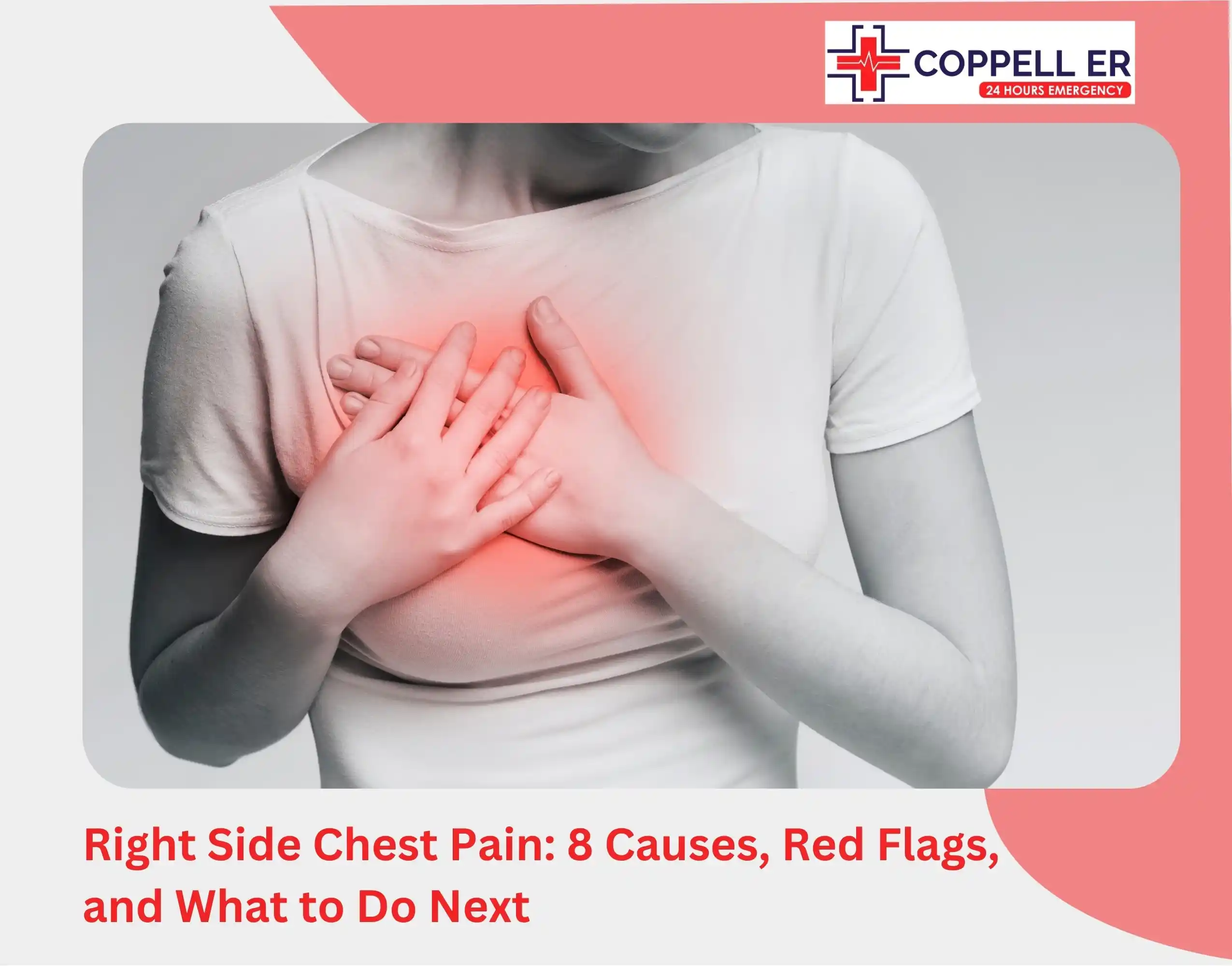
Right side chest pain rarely points to the heart, which sits on the left side. That fact calms the initial panic, but it doesn’t answer the real question: what’s causing it, and how worried should you be?
Pain on the right side of chest can come from the lungs, ribs, muscles, gallbladder, or nerves, and a handful of those causes are medical emergencies. Knowing which pattern you’re feeling is what separates a quick recovery from a missed diagnosis.
What Causes Right Side Chest Pain?
Right side chest pain usually traces back to the lungs, the chest wall muscles and ribs, the digestive tract, or nerves running along the rib cage. Heart-related causes are uncommon on this side. Some triggers resolve on their own; others, like a blood clot in the lung, demand emergency care.
The eight most common causes fall into four categories. The first category is the loudest. The last is the most often missed.
| Cause | System | Typical sensation | Severity |
| Pulmonary embolism | Lung | Sudden sharp pain with shortness of breath | Emergency |
| Pneumonia | Lung | Pain with coughing or deep breaths plus fever | Urgent |
| Pleurisy | Lung lining | Sharp, stabbing pain that worsens when breathing | Urgent |
| Collapsed lung (pneumothorax) | Lung | Sudden severe pain on one side, hard to breathe | Emergency |
| Costochondritis | Rib cartilage | Tender to the touch, worse with movement | Mild |
| Muscle strain | Chest wall | Reproduces when you press the spot | Mild |
| Gallstones or gallbladder inflammation | Digestive | Dull or sharp pain under right ribs after fatty meals | Urgent |
| Shingles or pinched nerve | Nervous system | Burning pain in a band, sometimes a rash | Moderate |
A PubMed study found costochondritis alone in 30% of emergency department chest pain patients, which is one reason most right-sided pain turns out to be musculoskeletal rather than cardiac.
The catch is that the small percentage that is dangerous, like a pulmonary embolism, can look similar at first. Ruling out the heart with an EKG remains part of any serious evaluation, and our breakdown of chest pain vs heart attack covers the cardiac side of that comparison in depth.
What Does Your Chest Pain Pattern Tell You?

Different chest pain patterns point to different causes. Sharp pain that worsens with each breath suggests the lungs or rib cage. Dull pain after eating points to the gallbladder. Pain that reproduces when you press a spot is almost always muscular. Matching what you feel to one of these patterns is the fastest way to narrow the field before you call a doctor.
- Sharp, stabbing pain that worsens with deep breathing: This usually points to the lung lining (pleurisy), an infection like pneumonia, or inflamed rib cartilage. A sudden version with shortness of breath could mean a pulmonary embolism or collapsed lung, both of which need an ER.
- Dull or burning pain that intensifies after a fatty meal: Think gallbladder, especially if it radiates to the right shoulder blade. Acid reflux can mimic this pattern but tends to come with heartburn and a sour taste.
- Pain that reproduces when you press the spot or move your arm: Almost always a muscle strain or costochondritis. A sharp pain in the right side of the chest that you can pinpoint with one finger is a classic muscular signature.
- Burning pain that follows a band across the ribs, with or without a rash: Shingles, especially in adults over 50. The pain often arrives a few days before the rash appears.
- Pain that comes and goes randomly with no clear trigger: Sharp pain right side of chest that comes and goes most often from muscle spasm, mild reflux, or anxiety-driven chest tension. Brief episodes that resolve fully are usually benign. If tightness rather than pain is what you’re feeling, our piece on chest tightness from anxiety walks through the difference.
- Constant pain that worsens hour over hour, even at rest. Inflammation, infection, or a vascular issue. This pattern is not for at-home management.
Right Side Chest Pain When Breathing: What It Could Be
Right side chest pain when breathing usually means the lungs, the lining around them, or the rib cartilage. Pleurisy, pneumonia, costochondritis, and a collapsed lung all present this way. A pulmonary embolism is rarer but the most dangerous version and needs an ER immediately.
Pain that sharpens every time your chest expands narrows the cause to a short list of conditions. All of them involve tissue that moves with each breath: lung tissue, the pleural lining, the rib cartilage, or the chest wall muscles.
- Pleurisy: Inflammation of the membrane around the lungs, usually from a viral infection. The pain is sharp and stops you from breathing deeply.
- Pneumonia: Lung infection that causes pain with deep breaths plus fever, cough, and fatigue. Right side chest pain when breathing is often the first noticeable symptom before the cough fully develops.
- Costochondritis: Inflamed cartilage where the ribs meet the breastbone. The pain sharpens during inhalation and reproduces when you press near the sternum.
- Collapsed lung (pneumothorax): Sudden, one-sided sharp pain with breathing difficulty. Tall, thin young adults and anyone with a recent chest injury are most at risk.
- Pulmonary embolism: A blood clot in a lung artery causing sharp pain in right side of chest, usually paired with shortness of breath, a racing heart, and sometimes coughing up blood. A true emergency.
One rule worth memorizing: sharp pain plus genuine shortness of breath, whether or not the pain is severe, requires an ER trip. That combination separates a muscle issue from a vascular or lung emergency.
Sharp Pain in the Right Side of the Chest in Women
Sharp pain right side of chest woman searches usually trace to the same causes as in men, but three patterns do skew female. Costochondritis is more common in women, gallbladder disease shows up more after age 40, and hormonal cycles can intensify reflux and muscle tension that all produce right-sided pain.
- Costochondritis hits women more often. Rib cartilage inflammation shows up disproportionately in women. The pain is sharp, reproduces when you press near the breastbone or along the ribs, and gets worse with arm movement. It’s not dangerous but can last several weeks.
- Gallbladder issues spike after 40. Women are roughly three times more likely than men to develop gallstones, and the right upper quadrant pain often radiates up into the chest. Look for a dull or sharp ache that worsens after fatty meals, sometimes traveling to the right shoulder blade. For anyone searching sharp pain right side of chest woman after dinner specifically, gallbladder is high on the list. Our piece on chest pain after eating breaks down the red flags.
- Hormonal cycles add their own layer. Estrogen fluctuations can change reflux severity, alter fluid retention around the rib cage, and amplify anxiety-driven chest tightness. Pregnancy stretches this further, with the growing uterus pushing organs up against the diaphragm. Right-sided sharp pain in late pregnancy is rarely cardiac, but it warrants a same-day call to your OB.
| If you are… | Most likely cause | What to watch for |
| Under 40, otherwise healthy | Costochondritis or muscle strain | Pain that reproduces on press |
| Over 40, post-meal pain | Gallbladder, reflux | Pain radiating to right shoulder |
| Pregnant | Reflux, rib stretch, muscle strain | Sudden severe pain or shortness of breath |
| Postmenopausal | Cardiac risk rises here, also reflux | Anything that feels heart-like |
Women’s cardiac symptoms can be subtle, even on the right side. Persistent right side chest pain in women paired with unusual fatigue, jaw discomfort, or nausea warrants an EKG, even when the pain doesn’t feel “heart-like.”
When Right Side Chest Pain Is an Emergency
Right side chest pain needs ER care when it comes with shortness of breath, lasts longer than 15 minutes, spreads to the arm or jaw, or follows a recent injury. Sudden severe pain with sweating or dizziness, even on the right side, should be treated as a heart event until ruled out.
Severity in chest pain isn’t measured by how much it hurts. It’s measured by what symptoms come with it and how fast it started.
| Tier | What it looks like | What to do |
| Home care | Mild ache or tenderness, reproduces on press, no breathing issue, follows a workout or strain | Rest, heat, OTC anti-inflammatories. Reassess in 48 hours. |
| Same-day visit | Persistent dull pain, mild shortness of breath, recent fever, post-meal patterns | Primary care or urgent care within 24 hours |
| ER right now | Sudden severe pain, especially sharp pain in right side of chest with shortness of breath, pain spreading to arm or jaw, sweating, fainting, coughing blood, or any blow to the rib cage | Drive in or call 911. Do not wait it out. |
The cluster that always overrides side-of-the-chest reasoning is pain plus shortness of breath plus a fast or irregular heartbeat. That combination flags a pulmonary embolism or major lung event regardless of which side the pain is on. The same goes for any chest pain after a fall, a car accident, or a hard blow to the rib cage.
If you’re unsure which tier applies, walking into expert care for chest pain gets you triaged in minutes rather than spending the night second-guessing.
How Coppell ER Evaluates Right Side Chest Pain
At Coppell ER, chest pain on the right side is treated as cardiac until proven otherwise. We start with an EKG and cardiac enzyme blood work to rule out the heart, then move to chest imaging, ultrasound, or CT to identify the actual source.
The workflow is built to answer the most dangerous question first.
Within minutes of arrival, a triage nurse checks your vitals and starts an EKG. Board-certified emergency physicians review the tracing and order labs, including cardiac enzymes, a complete blood count, and a D-dimer if a pulmonary embolism is on the table. Our on-site, COLA-certified laboratory turns these around quickly, which means decisions get made in real time rather than after a multi-hour delay.
From there, imaging narrows the source. A digital chest X-ray catches pneumonia, a collapsed lung, or rib fracture. A CT scan with contrast confirms or rules out a pulmonary embolism. Ultrasound checks the gallbladder if the pain pattern suggests it. The full workup, end to end, usually takes a fraction of the time a hospital ER would need for the same evaluation, because we run 24/7 with no wait and no appointment required.
When the diagnosis lands in a category we can treat fully, like costochondritis, mild pneumonia, or a muscle strain, we treat and discharge with follow-up guidance. When it points to something requiring surgery or hospital admission, like a confirmed pulmonary embolism or large pneumothorax, we stabilize the patient, manage pain and oxygen, and coordinate direct transfer to a hospital.
How to Ease Mild Right-Sided Chest Pain at Home
Mild right-sided chest pain from muscle strain or costochondritis usually responds to rest, gentle stretching, heat, and over-the-counter anti-inflammatories. Symptoms should improve within a week. If the pain worsens, spreads, or comes with shortness of breath, stop home care and seek evaluation.
Five steps for the cases that are clearly musculoskeletal:
- Stop the trigger: If the pain started after lifting, a workout, or a hard cough, ease off whatever movement reproduces it for several days.
- Apply heat, not ice: Heat relaxes the chest wall muscles and rib cartilage. A warm compress for 15 to 20 minutes, two or three times a day, helps most in the first few days.
- Use OTC anti-inflammatories: Non-prescription pain relievers reduce both the pain and the underlying inflammation. Follow the dose on the label.
- Sleep on the unaffected side: Lying on the painful side compresses the irritated tissue and slows recovery. Propping the painful side with a pillow keeps the area open.
- Stretch gently after 48 hours: Slow doorway pectoral stretches and shoulder rolls keep the chest wall from stiffening as it heals.
Come to the ER immediately if the pain spreads to the jaw, arm, or back; you develop shortness of breath, dizziness, or sweating; the area swells visibly; or the pain hasn’t improved in seven days. Any of those signals that the cause isn’t muscular.
FAQs
1. Can right side chest pain be a heart attack?
Right side chest pain rarely means a heart attack since the heart sits on the left. Cardiac pain can radiate right, especially in women and older adults. Chest pain with sweating or shortness of breath needs an EKG, regardless of side.
2. Why does sharp pain on the right side of my chest come and go randomly?
Intermittent sharp pain that comes and goes on the right side of chest most often signals muscle spasm, mild reflux, or anxiety. Brief episodes that resolve fully are usually benign. Recurrence over weeks warrants a doctor visit to rule out costochondritis or gallbladder issues.
3. Why do I get sharp stabbing pain on the right side of my chest?
Sharp stabbing pain on the right side usually traces to inflamed rib cartilage, the lung lining (pleurisy), or a chest wall muscle strain. Stabbing pain that worsens with deep breaths plus shortness of breath needs immediate evaluation to rule out a pulmonary embolism.
4. Can gas or acid reflux cause right side chest pain?
Yes. Trapped gas and acid reflux both cause right side chest pain, often as burning or pressure that worsens after eating or lying down. Antacids and diet adjustments usually help. Pain that doesn’t respond or comes with vomiting needs medical evaluation.
5. How long should right-sided chest pain last before I see a doctor?
Right-sided pain from muscle strain or costochondritis typically improves within seven days. Pain lasting longer, worsening day by day, or recurring warrants a doctor visit. Sudden severe pain or pain with shortness of breath needs an ER, not a wait.