
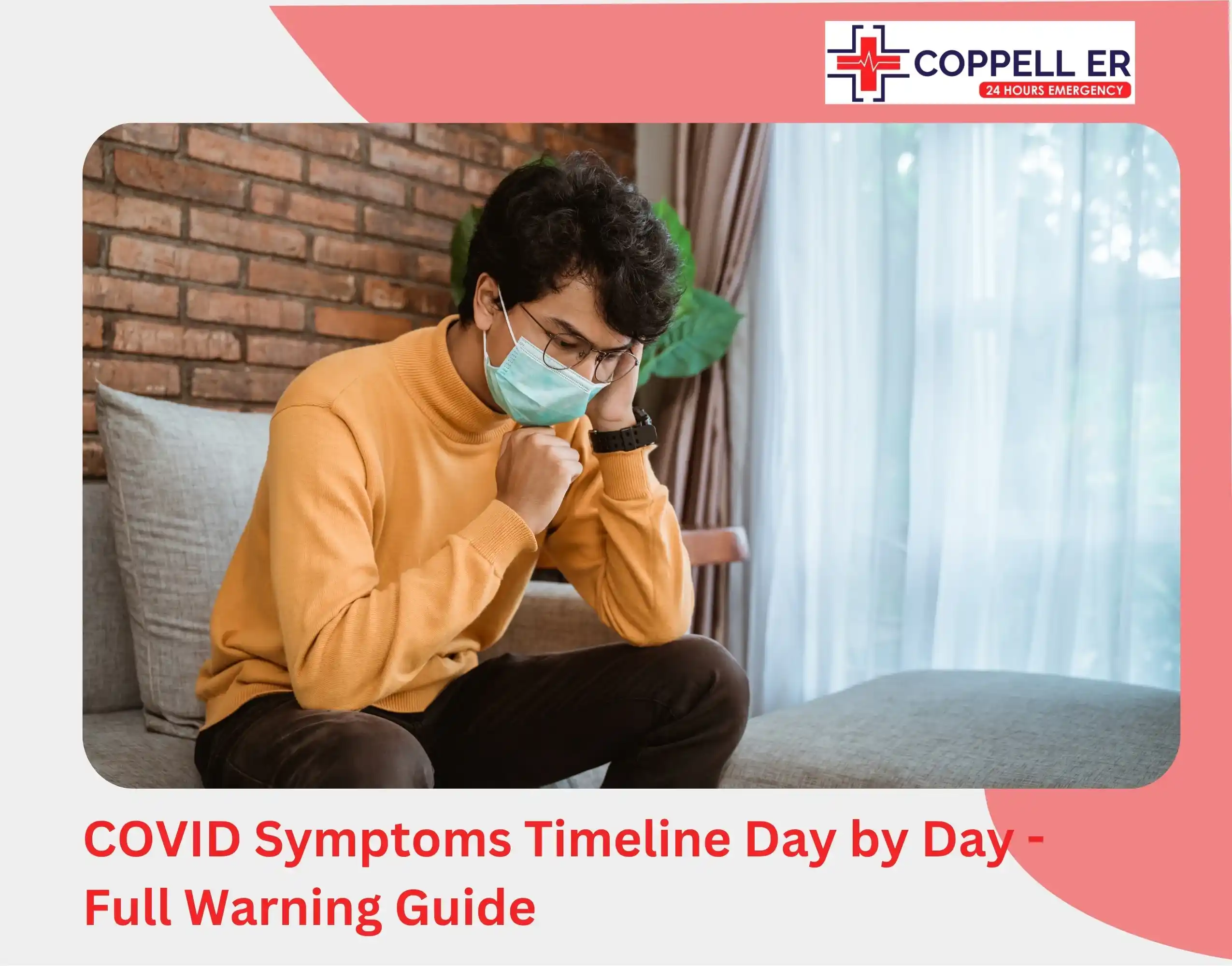
A 2026, doctor-informed breakdown of what to expect from Day 1 through recovery – and exactly when COVID becomes an emergency.
Quick Answer: The COVID Symptoms Timeline in 30 Seconds
Most people who catch COVID in 2026 start feeling symptoms 2 to 5 days after exposure. Day 1 to Day 3 usually feel like a heavy cold, sore throat, fatigue, congestion, and low-grade fever. Day 4 to Day 7 is when symptoms peak, and you’ll know if your case is mild or moving toward something more serious. Most healthy adults improve significantly by Day 8 to Day 10.
Cough and tiredness can linger for 2 to 3 weeks. Anyone with chest pain, trouble breathing, confusion, or bluish lips needs emergency care immediately. This guide walks you through the full covid symptoms timeline day by day, what’s normal at each stage, and the exact warning signs that mean it’s time to come to Coppell ER instead of waiting it out at home.
| ⚠️ If you’re having chest pain, severe shortness of breath, confusion, or bluish lips RIGHT NOW
Don’t wait for Day 7. Call 911 or come straight to Coppell ER at 720 N Denton Tap Rd. We’re open 24/7 with no wait times. Call 469-763-3136. |
How COVID Progresses in 2026 (What’s Different Now)
COVID in 2026 doesn’t look like the COVID of 2020. The dominant Omicron-lineage variants circulating this season, including JN.1 derivatives, the NB.1.8.1 “Nimbus” variant, and XFG “Stratus”, mostly infect the upper airways rather than driving deep into lung tissue.
Practically, that means:
- Symptoms come on fast, often within 24 hours, instead of building gradually.
- Sore throat, congestion, and fatigue dominate. Sharp “stabbing” sore throat is a hallmark of the Nimbus variant.
- Loss of taste and smell still happens, but is now reported in fewer than 10% of confirmed cases.
- High fevers and severe shortness of breath are less common in vaccinated adults.
- Most people resemble a bad cold or flu, but high-risk patients can still progress to pneumonia within 3 to 5 days.
COVID Symptoms Day by Day – The Full Timeline
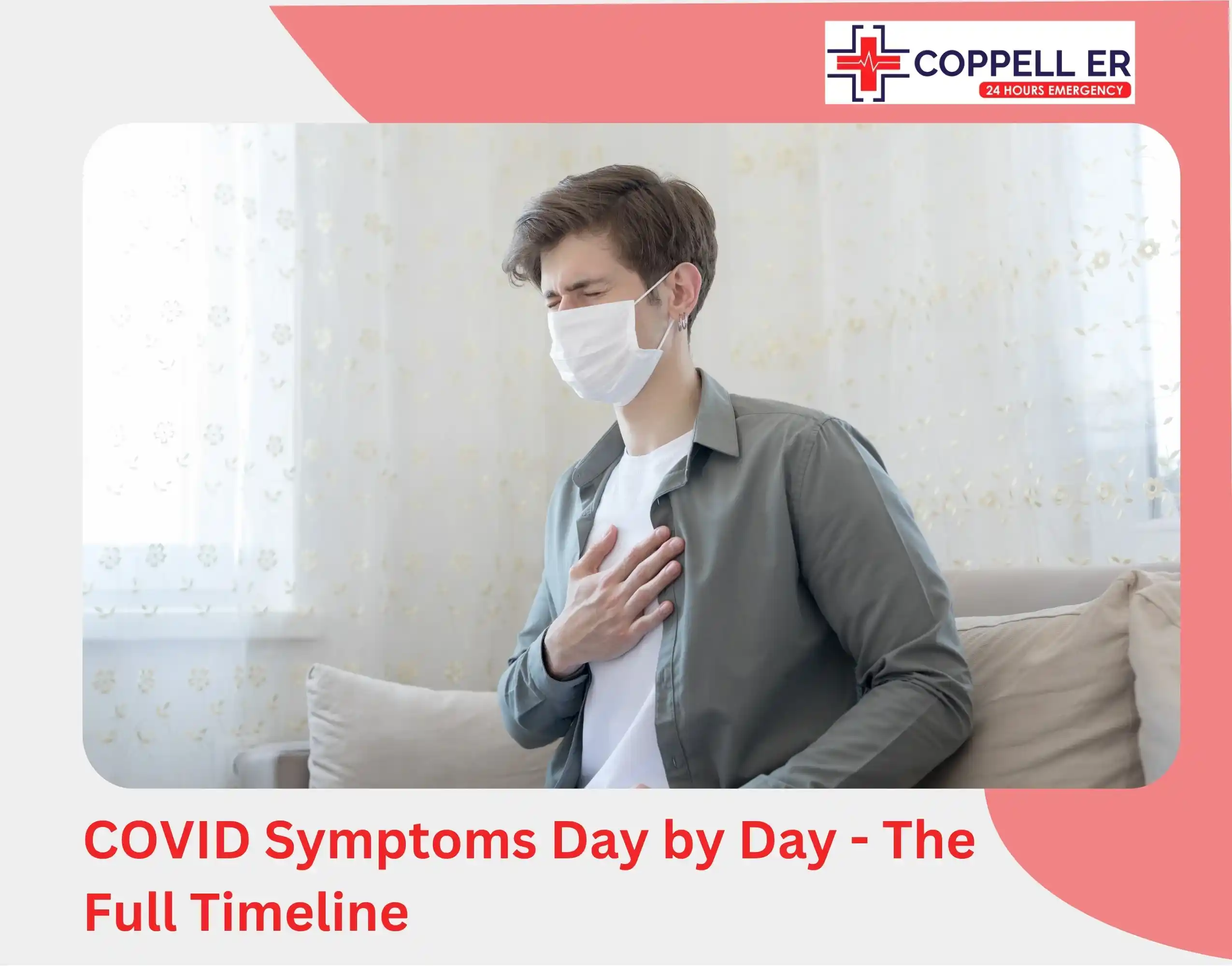
Below is the typical progression for an unvaccinated or partially vaccinated adult with a confirmed Omicron-variant infection. Vaccinated individuals or those with prior immunity often experience milder versions of the same pattern, sometimes wrapping up the entire timeline in 5 to 7 days instead of 14.
Day 1: First Signs – The “Something’s Off” Stage
Most people feel a sudden onset, not a slow build. The first noticeable symptom is usually one of these:
- Scratchy or painfully sharp sore throat
- Mild fatigue that feels heavier than usual
- Light headache
- Mild congestion or runny nose
- Low-grade temperature (under 100.4°F)
Many people mistake Day 1 for a cold or allergies. If you’ve had a known exposure or are in a community with high transmission, test now.
Day 2: Symptoms Multiply
By Day 2, the picture clarifies. You’ll likely have two or three of the Day 1 symptoms stacking together, plus:
- Body aches and muscle soreness
- Worsening fatigue, you feel “wiped out.”
- Cough begins, usually dry
- Fever may climb to 100.4-102°F
- Reduced appetite
Day 3: Symptoms Settle In
Day 3 is the “I definitely have something” day. Symptoms are clearly present but not yet at their worst:
- Persistent cough
- Stronger fever in some cases (102-103°F)
- Chest congestion or tightness
- Loss of taste or smell may appear (less common in 2026)
- Headache, sometimes severe
- Possible nausea or upset stomach
If you’re in a high-risk category (over 65, immunocompromised, pregnant, diabetic, or have heart/lung disease), Day 3 is the latest you should reach out for evaluation.
Day 4: The Pivot Point
Day 4 tells you which direction your case is heading. For most people, symptoms are at or near their peak but stable:
- Cough deepens, may become productive
- Fatigue is significant; even short tasks feel hard
- Fever continues but often responds to acetaminophen or ibuprofen
- Possible chest discomfort with deep breaths
Watch carefully for signs your case is escalating: rising fever that doesn’t respond to medication, increasing shortness of breath, or chest pain.
Day 5: Peak Symptoms for Most Cases
Day 5 is often the worst. Symptoms are at their maximum intensity:
- Cough is most disruptive, interferes with sleep
- Body aches and exhaustion peak
- Some patients develop shortness of breath with mild exertion
- Possible oxygen levels drop. If you have a pulse oximeter, anything under 94% warrants medical evaluation
Healthy, vaccinated adults usually plateau here. Higher-risk patients may continue to worsen — this is the most common day for emergency room visits related to COVID.
Day 6: Symptoms Start to Plateau or Worsen
By Day 6, your case has shown its hand:
- Mild cases: fever breaks, cough lingers, energy starts to return
- Moderate cases: symptoms stable but persistent
- Severe cases: shortness of breath worsens, oxygen drops, chest pressure may appear
If you’re getting worse on Day 6 instead of better, that’s a clinical red flag. Patients who progress to pneumonia typically do so between Days 5 and 7.
Day 7: The Turning Point
Day 7 is when most healthy adults feel a meaningful turn for the better:
- Fever resolves or significantly drops
- Energy slowly returns
- Cough continues but feels less constant
- Appetite returns
You’re often still contagious. CDC guidance recommends staying away from others until you’ve been fever-free for 24 hours (without medication) AND symptoms are improving.
Day 8: Mild Recovery Phase Begins
For most people with mild to moderate cases, Day 8 brings clear improvement:
- The fever should be gone
- Cough is loosening or becoming less frequent
- The sense of taste and smell start returning if affected
- Fatigue still present but manageable
Continue rest and hydration. Don’t return to intense exercise yet — cardiac complications are rare but more likely when patients resume strenuous activity during recovery.
Days 9 and 10: Most Symptoms Resolving
By Days 9-10, most healthy adults feel substantially better:
- Light activities feel doable again
- Cough may persist but is mild
- Fatigue lingers in waves rather than constantly
- Most people are no longer contagious by Day 10, though immunocompromised individuals may shed virus longer
Days 11 to 14: Residual Symptoms
This is the tail end of acute illness:
- Mild cough may continue (this can last weeks)
- Energy is mostly back, but still not 100%
- Some people notice brain fog or mild concentration problems
- Most people can safely resume normal activities, including moderate exercise
If you still have significant symptoms beyond Day 14, talk to a healthcare provider. Symptoms lasting 4+ weeks may indicate long COVID and need evaluation.
COVID Timeline at a Glance
Use this table as a quick reference. Save it, screenshot it, or share it with family members who may need it.
| Day | Typical Symptoms | What to Do |
| Day 1 | Sore throat, mild fatigue, light headache, low fever | Test for COVID. Start rest and hydration. |
| Day 2 | Body aches, cough begins, fever rising, fatigue worsens | Isolate. Retest if Day 1 was negative. |
| Day 3 | Persistent cough, fever, chest congestion, possible nausea | High-risk patients: seek antiviral evaluation now. |
| Day 4 | Deeper cough, peak fatigue, possible chest tightness | Watch for worsening breathing. Monitor oxygen if possible. |
| Day 5 | Symptom peak. Possible shortness of breath with exertion. | If breathing worsens or oxygen drops below 94%, go to ER. |
| Day 6 | Mild cases plateau; severe cases may worsen (pneumonia risk) | Worsening = ER visit. Improvement = continue home care. |
| Day 7 | Fever breaks for most. Cough continues. Energy slowly returns. | Still contagious. Continue isolation precautions. |
| Day 8 | Clear improvement. Cough loosening. Appetite returning. | Rest still essential. No intense exercise yet. |
| Days 9–10 | Most symptoms resolving. Light activities feel doable. | Generally non-contagious by Day 10 if fever-free 24+ hours. |
| Days 11–14 | Residual mild cough and fatigue. Brain fog possible. | Resume normal activities gradually. Monitor for long COVID. |
How the Timeline Differs by Severity
Not everyone follows the same course. Severity is shaped by age, vaccination status, prior infection, and underlying health conditions. Here’s how the timeline shifts:
Mild Cases (Most Healthy, Vaccinated Adults)
- Total duration: 5 to 7 days
- Symptoms: cold-like, sore throat, congestion, mild cough, fatigue
- Rarely involves high fever or breathing difficulty
- Home care is usually sufficient
Moderate Cases
- Total duration: 10 to 14 days
- Symptoms: significant fever, productive cough, body aches, and some shortness of breath with activity
- May benefit from antiviral medications if started early
- Medical evaluation recommended, especially around Day 5-7
Severe Cases (Higher Risk Patients)
- Risk groups: adults over 65, immunocompromised, pregnant, diabetic, heart or lung disease, obesity
- Symptoms can rapidly worsen between Days 5 and 10
- May progress to pneumonia, hypoxia (low blood oxygen), or respiratory failure
- Requires emergency evaluation, possible oxygen, IV fluids, or hospitalization
COVID Timeline in Children
Kids in 2026 generally follow the same day-by-day pattern but with some differences:
- Children often present with a runny nose, cough, fever, and decreased energy or appetite, symptoms that look like any other virus.
- Very young children may have a higher fever response.
- Febrile seizures are a real concern in toddlers and infants, call us or 911 if a seizure occurs.
- Dehydration is the most common reason pediatric COVID patients end up needing emergency care, especially when nausea, vomiting, or diarrhea reduce fluid intake.
Emergency Warning Signs – When COVID Becomes an ER Trip
These symptoms aren’t part of the normal timeline. If you experience any of them at any point during your illness, get emergency care immediately. Do not wait, do not drive yourself if you’re alone with serious symptoms – call 911.
Call 911 or Come to the ER Immediately If You Have:
- Trouble breathing or shortness of breath at rest
- Persistent chest pain or pressure
- New confusion or difficulty thinking clearly
- Inability to stay awake or be roused
- Bluish, gray, or pale lips, nail beds, or face (color may look different depending on skin tone)
- Blood oxygen level below 92% on a pulse oximeter
- Severe and persistent vomiting or inability to keep fluids down
- Signs of dehydration (no urination for 8+ hours, dizziness on standing)
- Fever over 103°F that won’t come down with medication
- Severe weakness or inability to walk normally
Special Warning Signs in Children:
- Fast or labored breathing, nostril flaring, chest pulling in
- Bluish lips or face
- Severe lethargy — unusually difficult to wake or unresponsive
- Signs of dehydration — no wet diapers, no tears when crying, dry mouth
- Fever in an infant under 3 months
- Seizures
|
🚨 Don’t Wait It Out If Warning Signs Appear Coppell ER is open 24/7 at 720 N Denton Tap Rd, Coppell, TX. No appointment needed. Minimal-to-zero wait times. Hospital-grade CT, X-ray, ultrasound, labs, and oxygen support on-site. Call 469-763-3136 or walk in. |
When to Visit Coppell ER for COVID Symptoms

Not every COVID case needs an ER visit – but some absolutely do. Here’s how to think about it.
Stay Home (with rest, fluids, OTC medications) If:
- Your symptoms are mild to moderate and stable
- You can keep fluids down
- You’re breathing normally at rest
- You’re not in a high-risk category
- You don’t have any of the warning signs above
Come to Coppell ER If:
- You’re high-risk and want quick evaluation for antiviral medication
- You have any of the emergency warning signs
- Your symptoms are getting worse instead of better past Day 5
- You can’t keep fluids down or are getting dehydrated
- You’re worried about your child’s breathing, energy, or hydration
- You need testing, a clear diagnosis, and a treatment plan — not just symptom relief
Why Coppell ER (Not Urgent Care)
Coppell ER is a freestanding emergency room – not urgent care. The difference matters when COVID symptoms escalate.
- Hospital-grade equipment on-site: CT scan, X-ray, ultrasound, full lab, cardiac markers.
- Board-certified ER physicians available 24/7.
- No appointment, no wait time – most patients are taken straight to an exam room.
- An in-house billing team and a no-surprise-billing policy.
- We accept most commercial insurance plans (we do not accept Medicare, Medicaid, or Tri-Care).
- Dedicated pediatric care for children of all ages.
If COVID has crossed from “feels like a cold” to “I’m getting worse,” that’s the moment a freestanding ER becomes the right call. Urgent care can’t run a chest CT. We can — and we’ll have results in minutes.
After Day 14: Recovery and Long COVID
Most people are fully back to baseline within 2 to 4 weeks. But not everyone. Roughly 5 to 10 percent of patients develop long COVID symptoms that persist beyond 12 weeks.
Common Long COVID Symptoms:
- Persistent fatigue, especially after activity (post-exertional malaise)
- Brain fog, memory problems, difficulty concentrating
- Shortness of breath that lingers for weeks or months
- Chest pain or heart palpitations
- Changes to taste or smell that don’t fully recover
- Sleep disturbances
- Headaches
- Joint or muscle pain
If symptoms persist beyond 4 weeks, talk to a healthcare provider for evaluation. Most people with long COVID see significant improvement within 3 months, though some take longer.
Preventing the Next Round

Now that you know what the timeline looks like, here’s how to avoid running it again:
- Get the updated 2025–2026 COVID vaccine. CDC recommends it for everyone 6 months and older. Updated vaccines target currently circulating sublineages.
- Wash hands frequently, especially before eating and after touching shared surfaces.
- Improve indoor ventilation, open windows, run HEPA filters in high-use rooms.
- Wear high-quality masks (KN95 or N95) during periods of high community transmission, especially if you’re high-risk or around someone who is.
- Stay home when sick, even if you’re not sure what it is.
- Test before indoor gatherings if anyone in the group is high-risk.
Frequently Asked Questions
Q: On which day of COVID do you feel the worst?
Most patients report Day 4 or Day 5 as the worst. This is when fever, fatigue, body aches, and cough typically peak together. Healthy vaccinated adults usually plateau and start improving by Day 6 or 7.
Q: How long does COVID last in 2026?
Mild cases generally last 5 to 7 days. Moderate cases last 10 to 14 days. Severe cases can extend longer and may require hospitalization. Lingering cough and fatigue can continue 2 to 3 weeks beyond the main illness.
Q: When is COVID most contagious?
Peak contagiousness runs from 1 to 2 days before symptoms start through the first 5 to 7 days of illness. Most immunocompetent people are no longer contagious 8 to 10 days after symptom onset. Immunocompromised individuals may shed virus longer.
Q: When should I go to the ER for COVID instead of urgent care?
Go to an ER like Coppell ER for any emergency warning signs (chest pain, trouble breathing at rest, confusion, bluish lips), oxygen levels under 92%, severe dehydration, or worsening symptoms after Day 5. Coppell ER has CT, X-ray, labs, and oxygen support that urgent care centers don’t provide.
Q: Can vaccinated people still get COVID in 2026?
Yes. Vaccines reduce the severity and duration of illness but don’t prevent every infection. Vaccinated patients typically experience milder symptoms and recover faster, often completing the entire timeline in 5 to 7 days instead of 10 to 14.
Q: When should kids go to the ER for COVID?
Bring children to the ER for fast or labored breathing, ribcage pulling in with each breath, bluish lips, severe lethargy, dehydration (no wet diapers, no tears), fever in infants under 3 months, or seizures. Coppell ER has specialized pediatric care available 24/7.
Q: Is loss of taste and smell still a COVID symptom in 2026?
Yes, but it’s much less common — reported in fewer than 10% of confirmed cases. Sore throat, fatigue, congestion, headache, and cough are the dominant 2026 COVID symptoms.
|
Need Care Now? Call Coppell ER: 469-763-3136 • Walk In: 720 N Denton Tap Rd, Coppell, TX 75019 • Open 24/7 • No appointment needed. |