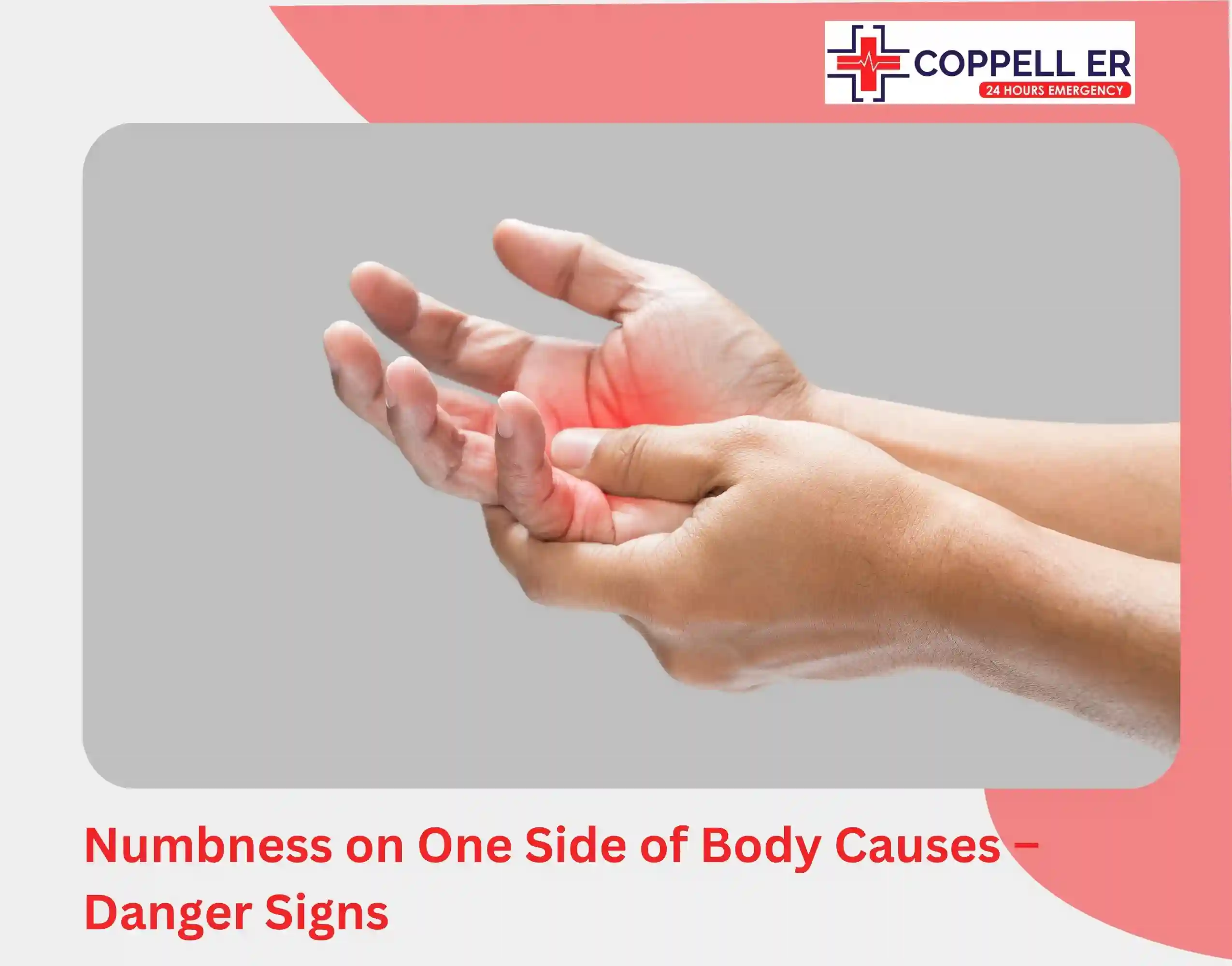
Sudden numbness on one side of the body, face, arm, leg, or all three, is one of the most specific stroke warning signs in medicine. The American Heart Association, CDC, and Johns Hopkins all list it as a primary stroke red flag. Until proven otherwise by an ER workup, any sudden one-sided numbness should be treated as a stroke or TIA (mini-stroke).
Not every one-sided numbness is a stroke, however. Other causes include pinched nerves (radiculopathy), migraine aura, multiple sclerosis, peripheral nerve injuries, Bell’s palsy, and rarely brain tumors. The distinguishing features are: how fast it came on, what other symptoms appeared with it, whether it affects multiple body parts on the same side, and whether you have stroke risk factors.
| 📌 Time Is Brain
During an active stroke, approximately 1.9 million brain cells die every minute treatment is delayed. The most effective stroke treatments (IV thrombolytics, mechanical clot removal) are only available within strict time windows from symptom onset, typically 3 to 4.5 hours for the most common interventions. The faster you arrive at the ER, the more brain you save. |
1. Why One-Sided Numbness Is Different From Numbness Everywhere

Numbness in both feet, both hands, or all over your body is usually NOT a stroke. Stroke symptoms are almost always one-sided, and there’s a specific anatomical reason.
The Brain Wiring Explanation
Your brain controls, and receives sensory signals from, the opposite side of your body. The left side of the brain controls the right side of the body, and the right side of the brain controls the left side. This is called “contralateral control.”
When a stroke damages a specific area of the brain, symptoms appear on the opposite side of the body. A stroke in the left side of the brain produces right-sided numbness, weakness, or speech problems. A stroke in the right side produces left-sided symptoms.
Why Bilateral (Two-Sided) Numbness Is Usually Not a Stroke
For symptoms to be bilateral, you’d need either:
- Two simultaneous strokes (extremely rare)
- A brainstem stroke affecting deep central structures (possible but rare and usually with other severe symptoms)
- Spinal cord damage (causes bilateral symptoms below the level of injury, different problem, also serious)
- Generalized neuropathy (gradual, not sudden, diabetes, B12 deficiency, autoimmune)
Numbness in both hands and feet, or in a “glove-and-stocking” distribution, is more typical of metabolic, nutritional, or peripheral nerve problems. Sudden one-sided numbness, by contrast, points sharply to a brain or spinal cord cause.
The Pattern Doctors Look For
ER physicians are specifically trained to recognize “hemibody” patterns, numbness or weakness affecting one side of the face, arm, and/or leg simultaneously. The more body parts on one side that are affected together, the more concerning the cause.
2. Stroke, The Cause to Rule Out First
Sudden one-sided numbness is one of the textbook stroke warning signs. Strokes happen when blood flow to part of the brain is interrupted, either by a clot (ischemic stroke, ~87% of cases) or by bleeding (hemorrhagic stroke, ~13%). Both produce similar symptoms; only imaging can tell them apart.
Stroke Warning Signs (BE FAST)
- B, Balance: sudden loss of balance or coordination
- E, Eyes: sudden vision changes, blurred or double vision
- F, Face: face drooping or numbness, usually one side
- A, Arms: arm weakness or numbness on one side
- S, Speech: slurred speech, trouble finding words
- T, Time: call 911 immediately
What One-Sided Stroke Numbness Feels Like
- Comes on SUDDENLY, over seconds to minutes, not hours or days
- Affects an entire side of the body: face, arm, leg, or any combination
- May feel like the limb is “dead,” tingling, or just absent
- Often paired with weakness on the same side
- Frequently accompanies speech, vision, or balance problems
- Does NOT resolve with movement, position changes, or shaking the limb
Stroke Treatment Windows
Stroke treatments are time-critical:
- IV thrombolytics (tPA, tenecteplase): best within 3 hours, possibly up to 4.5 hours
- Mechanical thrombectomy (clot removal): up to 24 hours in some cases for large-vessel strokes
- After these windows, treatment becomes supportive rather than restorative
The faster the diagnosis, the better the outcome. The single biggest mistake stroke patients make is waiting at home to see if symptoms improve.
3. Transient Ischemic Attack (TIA / Mini Stroke)
A TIA is a brief interruption of blood flow to the brain that causes stroke-like symptoms, including one-sided numbness, that resolve within minutes to hours, usually under an hour and always under 24 hours.
Why TIAs Are Still Emergencies
Even though TIA symptoms go away, the underlying problem doesn’t. TIAs are a warning shot, and the statistics are alarming:
- About 1 in 5 TIA patients have a full stroke within 90 days
- Up to 50% of those strokes occur within the first 48 hours
- Urgent treatment after a TIA reduces 90-day stroke risk by approximately 80%
Numbness that came and went isn’t a sign that you don’t need care, it’s a sign that you do, urgently.
| 🚨 Numbness That Resolved, But You’re Reading This Now
If you had sudden one-sided numbness earlier today or yesterday and it resolved on its own, you may have had a TIA. The window to prevent a full stroke is small. Coppell ER is open 24/7 with full stroke workup. Call 469-763-3136 or come to 720 N Denton Tap Rd. |
4. Other Neurological Causes That Need ER Evaluation
Stroke is by far the most common serious cause of sudden one-sided numbness, but it’s not the only one. Several other neurological conditions can produce similar symptoms.
Brain Hemorrhage
Bleeding in the brain from a ruptured blood vessel, aneurysm, or arteriovenous malformation. Symptoms include sudden one-sided numbness or weakness, often paired with severe “thunderclap” headache, vomiting, confusion, and sometimes loss of consciousness. This is a true neurosurgical emergency.
Brain Tumor
A brain tumor affecting motor or sensory areas can cause numbness, often progressive rather than sudden. Headaches that worsen over weeks, seizures, vision changes, or personality changes alongside numbness suggest a brain lesion needing imaging.
Multiple Sclerosis (MS) Attack
MS damages the protective coating of nerve fibers in the brain and spinal cord. Attacks often present with sudden numbness, vision changes, or weakness, sometimes on one side. MS symptoms typically evolve over hours to days rather than seconds. First-time symptoms always need ER or neurology evaluation.
Spinal Cord Compression or Injury
A herniated disc, spinal tumor, or trauma can compress the spinal cord. This causes numbness, weakness, and sometimes bowel or bladder problems. Often involves both legs (or both arms) depending on the level of injury, though it can occasionally be one-sided. Sudden onset with back pain is an emergency.
Seizure and Post-Seizure Weakness (Todd’s Paralysis)
After a focal (partial) seizure, the side of the body controlled by the seizure-affected brain area can be weak or numb for minutes to hours. Called Todd’s paralysis. Looks exactly like a stroke. Anyone who’s had a witnessed seizure followed by one-sided weakness needs ER evaluation to confirm the diagnosis.
Carotid or Vertebral Artery Dissection
A tear in the inner wall of one of the major arteries supplying the brain. Can be triggered by neck trauma, sudden movements (sports, chiropractic manipulation), or sometimes spontaneously. Causes one-sided weakness, numbness, neck pain, and is the most common cause of stroke in adults under 45.
5. Migraine Aura, The Stroke Mimic
Migraine with aura is the most important non-emergency cause of one-sided numbness, and the one most easily confused with a stroke. Understanding the differences is critical, because aura can be alarming but isn’t dangerous, while stroke is.
What Migraine Aura Feels Like
- Sensory changes, tingling or numbness that spreads gradually over 5 to 20 minutes
- Often starts in the hand and travels up the arm or to the face
- Visual aura, flashing lights, zigzag patterns, blind spots (most common)
- Sometimes speech difficulties
- Usually followed by a headache within an hour
- Resolves within 60 minutes typically
Migraine Aura vs Stroke, Key Differences
- Speed: aura DEVELOPS gradually over minutes; stroke symptoms hit immediately
- Spread: aura tends to spread slowly across body parts; stroke affects an entire side at once
- Visual symptoms: aura often has positive features (flashing lights, zigzags); stroke usually has negative features (loss of vision, dark spots)
- Headache: migraine aura is usually followed by a headache; stroke headache is sudden, severe, and “different from any before”
- History: migraine aura usually has a long pattern of occurrences; stroke is typically the first time
Important caveat: even people with known migraine should get evaluated for a first-time aura, a clearly different pattern of aura, or aura that doesn’t fully resolve. Migraineurs are at slightly elevated stroke risk, and assuming “it’s just migraine” can be wrong.
6. Peripheral Nerve Causes (Usually Not Emergencies)
Many cases of one-sided numbness aren’t from the brain at all, they’re from nerves being compressed or irritated outside the brain and spinal cord. These are typically not emergencies, though they may still need medical evaluation.
Pinched Nerve (Radiculopathy)
Nerve compression in the neck (cervical) or lower back (lumbar) causes numbness, tingling, and sometimes weakness following the specific nerve’s path. Hallmarks:
- Numbness follows a defined “strip”, for example, only the thumb and index finger, or only the outer thigh
- Often accompanied by neck or back pain
- Worse with specific movements or positions
- Develops over days to weeks, not seconds
- Doesn’t involve the face
Carpal Tunnel Syndrome
Compression of the median nerve at the wrist. Causes numbness and tingling in the thumb, index, middle, and half of the ring finger. Often worse at night, with repetitive hand use, or when holding a phone. Doesn’t affect the leg or face.
Cubital Tunnel Syndrome
Compression of the ulnar nerve at the elbow. Causes numbness in the ring and little fingers, sometimes the inside of the forearm. Often triggered by prolonged elbow bending.
Sciatica
Compression of the sciatic nerve in the lower back, often from a herniated disc. Causes pain, numbness, or tingling running from the lower back down one leg. Often worsened by sitting or coughing.
Bell’s Palsy
Sudden weakness or numbness of one side of the face caused by inflammation of the facial nerve, not a stroke. Distinguishing features:
- Affects ONLY the face, not the arm or leg
- Usually affects the entire side of the face including the forehead (in stroke, the forehead is often spared)
- Often follows a viral illness
- May cause changes in taste or sensitivity to sound on the affected side
- Develops over hours to days
Important: Bell’s palsy should be diagnosed by a doctor, never by self-assessment, because stroke can mimic it. If facial drooping appears with any arm or leg symptoms, treat it as a stroke.
Peripheral Neuropathy
Damage to peripheral nerves from diabetes, vitamin deficiencies (especially B12), alcohol, chemotherapy, or autoimmune disease. Typically symmetric (both feet, then both hands), gradual, and worse at night, NOT a sudden one-sided event.
7. Other Causes of Numbness Worth Knowing
Vitamin B12 Deficiency
Severe B12 deficiency causes nerve damage with numbness, tingling, weakness, and sometimes cognitive changes. Usually develops gradually over months and is symmetric, but can rarely cause more one-sided symptoms. Treatable with B12 supplementation.
Alcohol-Related Neuropathy
Chronic heavy alcohol use damages nerves, producing numbness, typically symmetric in feet and hands, gradual onset.
Medication Side Effects
Some chemotherapy drugs, certain antibiotics (metronidazole, isoniazid), and some HIV medications can cause numbness. Usually symmetric.
Anxiety and Hyperventilation
Panic attacks cause rapid breathing, lowering carbon dioxide levels, which can produce tingling, typically in both hands, around the mouth, and sometimes the feet. Usually accompanied by chest tightness, racing heart, sweating, sense of doom. Symmetric, not one-sided.
Lyme Disease (in endemic areas)
Tick-borne infection can cause neurological symptoms weeks to months after the bite, including facial nerve palsy (often one-sided), tingling, and sometimes weakness.
Tumor Compression Outside the Brain
Tumors compressing nerves in the spine or peripheral structures can cause regional numbness, usually following a specific nerve distribution rather than an entire body side.
8. Sudden vs Gradual, The Critical Timing Distinction
How fast the numbness developed is often the single most useful clue to its cause.
Sudden Onset (Seconds to Minutes)
Suggests vascular causes, meaning blood vessels. The classic vascular causes are:
- Stroke
- TIA
- Brain hemorrhage
- Vertebral or carotid artery dissection
Sudden one-sided numbness is treated as a stroke until proven otherwise. Always.
Sub-Acute Onset (Minutes to a Few Hours)
Slower development, over 20 minutes to several hours, is more consistent with:
- Migraine with aura (especially with visual symptoms and headache)
- Multiple sclerosis attack
- Post-seizure (Todd’s paralysis)
- Some forms of nerve inflammation
Gradual Onset (Days to Weeks)
Slow onset usually points away from emergency causes toward:
- Pinched nerves and radiculopathy
- Brain tumor (slow growth)
- MS in some presentations
- Peripheral neuropathy
- B12 deficiency
- Medication side effects
Intermittent or Recurrent
Numbness that comes and goes, sometimes seconds, sometimes minutes, can suggest:
- TIAs (highest priority to rule out)
- Migraine aura
- MS (recurrent attacks)
- Pinched nerve with positional triggers
- Anxiety/hyperventilation episodes
9. Harmless Tingling vs Emergency Numbness, How to Tell
Everyone has experienced a limb “falling asleep.” Most of these are harmless. Here’s how to distinguish them from the dangerous kind.
| Feature | Description |
| HARMLESS TINGLING | Comes on gradually after sitting, sleeping, or staying in one position. Localized to one body part (one foot, one hand). Pins-and-needles sensation. Resolves completely within minutes of moving the limb. No other symptoms. |
| EMERGENCY NUMBNESS | Comes on SUDDENLY without obvious cause. Affects an entire side of the body, face, arm, and/or leg together. Does NOT resolve with movement. Often accompanied by weakness, vision changes, speech problems, or severe headache. |
If It Was Brief But You’re Not Sure, Still Get Evaluated
“It went away after 10 minutes” is exactly how TIAs present. Brief symptom resolution doesn’t mean the cause has resolved. The window to prevent a full stroke after a TIA is small, usually 48 hours, but using that window can reduce future stroke risk by 80%.
10. Who Should Treat Sudden Numbness Most Seriously

These factors lower the threshold for ER evaluation. The same numbness in different patients carries dramatically different risks.
- Age over 55, stroke risk increases significantly
- High blood pressure (the biggest single modifiable stroke risk factor)
- Atrial fibrillation, major stroke risk; many people don’t know they have it
- Diabetes
- High cholesterol
- Smoking, current or recent
- History of TIA or prior stroke
- Family history of stroke or early heart disease
- Obesity
- Sedentary lifestyle
- Heavy alcohol use
- Sleep apnea
- Pregnancy or postpartum (slight stroke risk increase)
- Hormonal contraceptives, especially in smokers
- Recent neck injury, whiplash, or chiropractic manipulation (artery dissection risk)
- Active cancer treatment
- Sickle cell disease
- Migraine with aura
- Recreational drug use (especially stimulants like cocaine, amphetamines)
11. The 30-Second Self-Check
Use this only when symptoms aren’t actively progressing. If you have any of the BE FAST signs, face droop, arm weakness, slurred speech, vision changes, skip the self-check and call 911.
Ask Yourself:
Did the numbness come on suddenly, over seconds to a few minutes?
- YES → vascular cause possible → ER evaluation needed
- NO, gradually over days/weeks → less urgent but still worth evaluation
Does the numbness affect an entire side of your body (face + arm, arm + leg, or all three together)?
- YES → strongly suggests brain or spinal cord cause → call 911
- NO, just a specific small area → more consistent with peripheral nerve
Is the numbness accompanied by ANY of these, weakness, face drooping, slurred speech, vision changes, severe headache, confusion?
- YES → call 911 immediately
- NO → continue self-assessment
Is the numbness only in one specific spot (one finger, just the outer thigh, just the lower lip)?
- YES → more consistent with peripheral nerve compression
- NO → cause less clear; evaluation appropriate
Does the numbness resolve with movement, stretching, or position change?
- YES → suggests pressure-related cause (limb fell asleep, etc.)
- NO → cause less benign; evaluation needed
Do you have stroke risk factors?
- YES (over 55, hypertension, AFib, diabetes, smoking, etc.) → lower threshold significantly
- NO → vascular causes statistically less likely but not impossible
Is this the first time you’ve experienced this kind of numbness?
- YES → ER evaluation appropriate for any sudden episode
- NO, recurring with familiar pattern (migraine, known disc problem) → manage as before if pattern unchanged
12. Why Coppell ER for Sudden One-Sided Numbness

One-sided numbness is potentially the most time-sensitive symptom in emergency medicine. The longer treatment is delayed, the more brain tissue dies, and the worse the long-term outcome. Coppell ER has the full diagnostic capability of a hospital emergency department, available 24/7.
Stroke-Specific Capabilities On-Site
- CT scan within minutes of arrival, first test to rule out hemorrhage
- MRI when needed for more sensitive stroke imaging
- CT angiography for vertebral or carotid artery dissection
- Carotid ultrasound
- EKG and continuous cardiac monitoring (rules out AFib)
- Echocardiogram for cardiac sources of clots
- Full neurological examination by ER physicians
- Comprehensive blood work
Stroke Treatment
- IV thrombolytics (tPA) for eligible patients within the treatment window
- Antiplatelet and anticoagulation therapy
- Blood pressure management
- Stabilization and rapid transfer to comprehensive stroke centers for mechanical thrombectomy when needed
- Coordination with neurology and neurosurgery
Workup for Non-Stroke Causes
- Imaging for tumors, MS, or structural causes
- Lab work for nutritional, infectious, or autoimmune causes
- EMG/nerve conduction studies when indicated (typically outpatient)
- Pain management for confirmed musculoskeletal causes
Why Coppell ER
- Open 24/7, strokes don’t wait for office hours
- No appointment, walk straight to an exam room
- Minimal-to-zero wait times, critical when minutes equal brain cells
- Board-certified ER physicians on every shift
- Hospital-grade imaging and labs in a private-practice setting
- In-house billing team and no-surprise-billing policy
- Most commercial insurance plans accepted (Medicare, Medicaid, and Tri-Care are not accepted)
| Sudden Numbness on One Side, Don’t Wait It Out
If symptoms are active right now, call 911. If you had an episode earlier that resolved, come to Coppell ER for evaluation. Open 24/7 at 720 N Denton Tap Rd. CT, MRI, EKG, and ER physicians on-site. Call 469-763-3136. |
Frequently Asked Questions
Q: Is one-sided numbness always a stroke?
No, but it must be treated as a stroke until proven otherwise by medical evaluation. Other causes include TIA, migraine aura, multiple sclerosis attack, brain tumor, brain hemorrhage, Bell’s palsy, pinched nerve, and post-seizure paralysis. Only an ER workup with neurological exam and imaging can reliably tell them apart.
Q: How fast does stroke numbness come on?
Stroke numbness develops over seconds to a few minutes, sudden, not gradual. If numbness builds up over 20+ minutes, especially with visual symptoms followed by headache, it’s more likely migraine aura. If it develops over days, it’s more likely a non-emergency neurological condition or peripheral nerve issue.
Q: My left arm went numb, is that a stroke?
Possibly, depending on context. Left arm numbness alone, without face involvement, without leg involvement, without weakness or speech changes, is more often from a pinched nerve, carpal tunnel, or even cardiac causes (left arm numbness can rarely accompany a heart attack). Left arm numbness PLUS face drooping, slurred speech, or leg weakness is highly suspicious for stroke. Get evaluated either way if it came on suddenly.
Q: Can anxiety cause one-sided numbness?
Anxiety can cause numbness and tingling, but it’s typically symmetric, both hands, around the mouth, sometimes both feet, from hyperventilation. Strictly one-sided numbness from anxiety alone is uncommon. Don’t assume anxiety until cardiac and neurological causes have been ruled out, especially for a first-time episode.
Q: What’s the difference between Bell’s palsy and a stroke?
Bell’s palsy affects ONLY the face, typically the entire side including the forehead. Stroke affecting the face typically spares the forehead (you can still wrinkle the affected forehead). More importantly: Bell’s palsy doesn’t cause arm or leg weakness, but a stroke can. Any combination of face droop with arm or leg weakness is treated as a stroke, not Bell’s palsy. Diagnosis must come from a doctor, never self-assessment.
Q: Can a pinched nerve in my neck cause one-sided numbness?
Yes, cervical radiculopathy can cause numbness, tingling, and sometimes weakness in the arm and hand. Distinguishing features: typically follows a specific nerve distribution (not the whole side), often accompanied by neck pain, worsened by certain neck positions, develops over days, and doesn’t affect the face or leg. A pinched neck nerve cannot explain sudden numbness involving the face.
Q: Is one-sided numbness during pregnancy an emergency?
Yes, pregnancy carries elevated stroke risk, particularly in the third trimester and postpartum. Pregnant women with sudden one-sided numbness, weakness, severe headache, or vision changes need immediate ER evaluation. Don’t assume “it’s just pregnancy” for sudden neurological symptoms.
Q: My numbness has come and gone several times, should I be worried?
Yes, recurrent transient one-sided numbness can be TIAs, which dramatically raise short-term stroke risk. About 1 in 5 TIA patients have a full stroke within 90 days, with up to half occurring in the first 48 hours. Multiple TIAs are a strong warning. Get to an ER for urgent evaluation.
Q: Can I drive myself to the ER if I have sudden one-sided numbness?
No. Driving with active neurological symptoms is dangerous, you could lose control if symptoms worsen. Call 911. Paramedics can begin stroke assessment and notify the hospital so a team is ready when you arrive. EMS-transported stroke patients receive treatment faster than walk-in patients.
Q: What tests will the ER do for one-sided numbness?
Standard stroke workup includes neurological exam, CT scan (and sometimes MRI), EKG, blood work, and often CT angiography or carotid ultrasound. If a stroke or TIA is confirmed, an echocardiogram and longer-term cardiac monitoring may follow. The initial workup typically takes about an hour.
Q: How can I prevent another episode?
If stroke or TIA is the cause, prevention focuses on managing risk factors: control blood pressure, treat atrial fibrillation, manage cholesterol, control diabetes, stop smoking, treat sleep apnea, exercise regularly, eat a Mediterranean-style diet, and take prescribed medications consistently. The American Stroke Association estimates 80% of strokes are preventable.
The Bottom Line
Sudden one-sided numbness is one of the most reliable single warning signs of stroke in medicine. It’s the symptom that ER physicians and stroke neurologists react to fastest, and the symptom that patients most often dismiss because “it’s not that bad” or “it went away.” Both reactions can be fatal.
If numbness affects an entire side of your body, came on suddenly, or is paired with any other neurological symptom, face drooping, slurred speech, vision changes, severe headache, or weakness, treat it as a stroke and call 911 immediately. Don’t wait. Don’t drive yourself. Don’t assume it will resolve.
If it already resolved, that’s a TIA until proven otherwise, and a TIA is itself an emergency. The window to prevent the next stroke is short. Coppell ER is open 24/7 with full stroke workup capability. Brain cells die by the minute. Use the time you still have.
| Time Is Brain. Don’t Waste It.
Call Coppell ER: 469-763-3136 • Walk in: 720 N Denton Tap Rd, Coppell, TX 75019 • Open 24/7 • CT, MRI, EKG, and ER physicians on-site. For active stroke symptoms, call 911 first, not us. |
Medical Disclaimer
This article is for general educational purposes and is not medical advice. Reading this content does not establish a doctor-patient relationship. Causes of numbness vary widely by individual. For personal medical questions, consult a licensed healthcare provider. If you suspect a stroke, call 911 immediately, do not rely on online articles to self-diagnose.
Sources: American Stroke Association, Stroke Symptoms; CDC, Signs and Symptoms of Stroke; National Institute on Aging, Stroke Signs, Causes and Treatment; Johns Hopkins Medicine, Stroke; Cleveland Clinic, Hemiparesis; Northwestern Medicine, Stroke Warning Signs; Memphis Neurology, Subtle Symptoms of Acute Stroke.